
Skip to content
detarc.net
Weekly Net
Tuesdays • 8:00 PM
146.940 MHz • PL 141.3
Club Meeting
4th Thursday • 6:30 PM
Fuller Springs VFD
Conditions
Loading...
Members
🔒 Login
  • Home
  • About UsExpand
    • Who We Are
    • Leadership
    • Meetings
    • Repeater and Club InfoExpand
      • NESTxLINK Repeater Network
    • Join DETARC
  • Getting Started in Ham RadioExpand
    • What is Ham Radio?
    • Begin Your Amateur Radio Journey
    • Local Amateur Radio Testing
    • You Passed Your Technician Exam. Now What?
    • Help Others become Hams
    • New Operator Resources
  • ResourcesExpand
    • KG5FCZ’s Ham Clock
    • DETARC PDF Library Archives
    • Antennas and Coax
    • Digital ModesExpand
      • FT(x)
      • Winlink
    • Emergency CommunicationsExpand
      • ARES
      • ICS
      • RACES
    • OperatingExpand
      • HF
      • POTA
      • Satellite
      • VHF/UHF
    • Technical Articles
  • Calendar of Events
  • News
  • Member’s OnlyExpand
    • Net Attendance
    • Net Attendance Awards
    • Club Documents
    • Meeting Minutes
    • Publishing Tools and GuidesExpand
      • Member Only Publishing Tools
      • Generating AI images that conform to the DETARC Visual Style Guide
      • DETARC Visual Style Guide
detarc.net
Loading...
  • Making Your First Contact
    New Operator Resources | Education

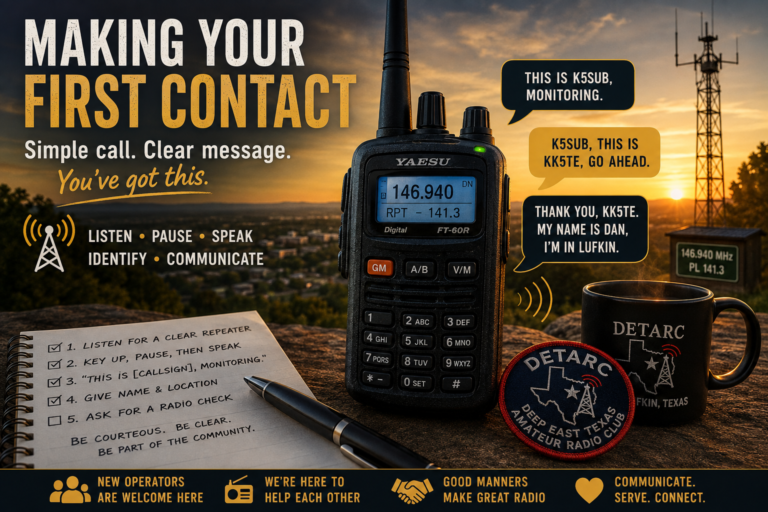
    Making Your First Contact

    ByDanny Butler (K5SUB) 16-August-202616-August-2026

    Excerpt: New Technician ham in Lufkin or Deep East Texas? Learn making your first local radio contact with practical, beginner-friendly guidance from DETARC. The Short Version The first contact is often the hardest because it feels public. A simple, honest call is enough. If you are newly licensed, do not measure success by how much you…

    Read More Making Your First ContactContinue

  • Repeater Etiquette Without Being Nervous
    New Operator Resources

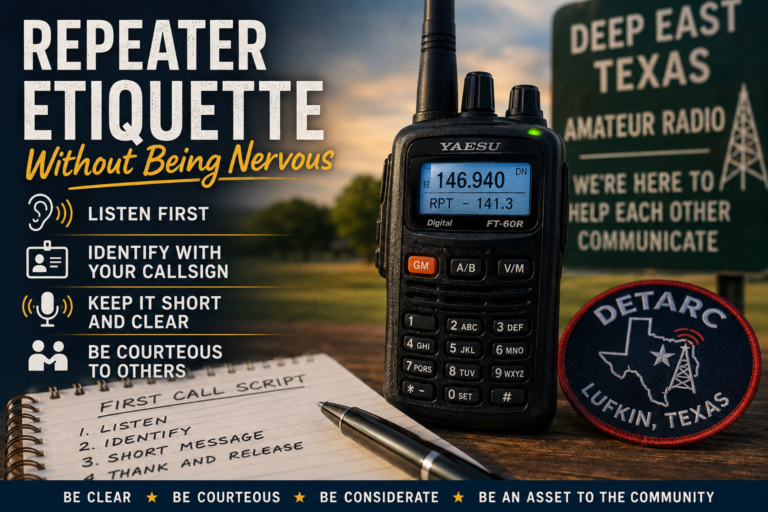
    Repeater Etiquette Without Being Nervous

    ByDanny Butler (K5SUB) 16-August-202616-August-2026

    Excerpt: New Technician ham in Lufkin or Deep East Texas? Learn using good repeater manners with practical, beginner-friendly guidance from DETARC. The Short Version Good etiquette is not about sounding fancy. It is about being clear, courteous, legal, and easy to work with on the air. If you are newly licensed, do not measure success by…

    Read More Repeater Etiquette Without Being NervousContinue

  • Opinion

    FCC Proceeding to Expand Technician Privileges

    ByJim Edmondson (AE5JE) 2-August-20262-August-2026

    I happened upon an essay by Tom Salzer, KJ7T on the internet yesterday. It seems that there was a petition filed with the FCC in 2018 that has not seen any action. This petition would add selected frequencies to the Technician license class for digital and phone operation. Tom’s writeup is excellent, so see it…

    Read More FCC Proceeding to Expand Technician PrivilegesContinue

  • Understanding PL Tones, Offsets, and Repeater IDs
    New Operator Resources | Operating

    Understanding PL Tones, Offsets, and IDs

    ByDanny Butler (K5SUB) 31-July-20261-August-2026

    SEO Title: Understanding PL Tones, Offsets, and Repeater IDs | DETARC Meta Description: Confused by PL tones, repeater offsets, or Morse code IDs? Learn what they are, why repeaters use them, and how to program your radio with confidence. 146.940 (-) 141.3 If you’ve looked at a repeater directory or club website, you’ve probably seen something like…

    Read More Understanding PL Tones, Offsets, and IDsContinue

  • Understanding Repeaters
    New Operator Resources

    Understanding Repeaters

    ByDanny Butler (K5SUB) 31-July-202631-July-2026

    “Wait… How Can Everyone Hear Me?” One of the first mysteries every new ham encounters goes something like this: You key your handheld radio from your driveway in Lufkin. A few seconds later, someone answers from twenty or thirty miles away. You look down at your radio and think: “There’s no way this little five-watt…

    Read More Understanding RepeatersContinue

Page navigation

Previous PagePrevious 1 2 3 4 5 6 … 13 Next PageNext
New to Ham Radio? Start Here.

QRZ Callsign Search

Upcoming Events


Latest Posts

  • Software Every Ham Should Know
  • Raspberry Pi Projects for Hams
  • Digital Voice DMR, Fusion, and D-STAR
  • APRS For Beginners
  • Getting Started with Winlink

Archives


Categories

  • Amateur Radio Basics
  • Antennas and Coax
  • APRS
  • Club Documents
  • Digital Modes
  • DMR
  • Education
  • FT(x)
  • HF
  • ICS
  • Meeting Minutes
  • Member's Only
  • New Operator Resources
  • News
  • Operating
  • Opinion
  • POTA
  • Reference Materials
  • Technical Articles
  • Uncategorized
  • VHF/UHF
  • Winlink

Tag Cloud

Allmon3 AllStarLink Amateur Radio Basics Antennas APRS ASL3 Contesting CW D-Star Deep East Texas DETARC Digital Modes DMR DX FM Getting Started HF Logging Lufkin TX Morse Code New Ham New Hame New Operators Operating Tips Outreach POTA Propogation QSL Cards Raspberry Pi Repeaters SHARI Pi3U Software Solar Weather Supermon swr Technician License Testimony WSPR

© 2026 Deep East Texas Amateur Radioclub Inc- WordPress Theme by Kadence WP

  • Home
  • About Us
    • Who We Are
    • Leadership
    • Meetings
    • Repeater and Club Info
      • NESTxLINK Repeater Network
    • Join DETARC
  • Getting Started in Ham Radio
    • What is Ham Radio?
    • Begin Your Amateur Radio Journey
    • Local Amateur Radio Testing
    • You Passed Your Technician Exam. Now What?
    • Help Others become Hams
    • New Operator Resources
  • Resources
    • KG5FCZ’s Ham Clock
    • DETARC PDF Library Archives
    • Antennas and Coax
    • Digital Modes
      • FT(x)
      • Winlink
    • Emergency Communications
      • ARES
      • ICS
      • RACES
    • Operating
      • HF
      • POTA
      • Satellite
      • VHF/UHF
    • Technical Articles
  • Calendar of Events
  • News
  • Member’s Only
    • Net Attendance
    • Net Attendance Awards
    • Club Documents
    • Meeting Minutes
    • Publishing Tools and Guides
      • Member Only Publishing Tools
      • Generating AI images that conform to the DETARC Visual Style Guide
      • DETARC Visual Style Guide