
Skip to content
detarc.net
Weekly Net
Tuesdays • 8:00 PM
146.940 MHz • PL 141.3
Club Meeting
4th Thursday • 6:30 PM
Fuller Springs VFD
Lufkin Weather
Loading...

Members

🔒 Login

  • Home
  • About UsExpand
    • Who We Are
    • Leadership
    • Meetings
    • Repeater and Club InfoExpand
      • NESTxLINK Repeater Network
  • Getting Started in Ham RadioExpand
    • Begin Your Amateur Radio Journey
    • What is Ham Radio?
    • Local Amateur Radio Testing
    • New Amateur Radio Resources
    • Help Others become Hams
  • ResourcesExpand
    • DETARC PDF Library Archives
    • Antennas and Coax
    • Digital ModesExpand
      • FT(x)
      • Winlink
    • Emergency CommunicationsExpand
      • ARES
      • ICS
      • RACES
    • OperatingExpand
      • HF
      • POTA
      • Satellite
      • VHF/UHF
    • Technical Articles
  • Calendar of Events
  • News
  • Member’s OnlyExpand
    • Net Attendance
    • Club Documents
    • Meeting Minutes
    • Publishing Tools and GuidesExpand
      • Member Only Publishing Tools
      • Generating AI images that conform to the DETARC Visual Style Guide
      • DETARC Visual Style Guide
detarc.net
  • Incident Command System: Why Amateur Radio Operators Learn ICS
    ICS | Uncategorized

    Incident Command System: Why Amateur Radio Operators Learn ICS

    ByDanny Butler (K5SUB) 24-June-20262-July-2026

    The Incident Command System, commonly known as ICS, is a standardized approach to managing emergency incidents and planned events. Developed to improve coordination among responding agencies, ICS has become a fundamental part of emergency management throughout the United States. Many amateur radio volunteers become familiar with ICS through organizations such as ARES, RACES, and local…

    Read More Incident Command System: Why Amateur Radio Operators Learn ICSContinue

  • Winlink: Email Without the Internet
    Operating | Uncategorized | Winlink

    Winlink: Email Without the Internet

    ByDanny Butler (K5SUB) 24-June-20262-July-2026

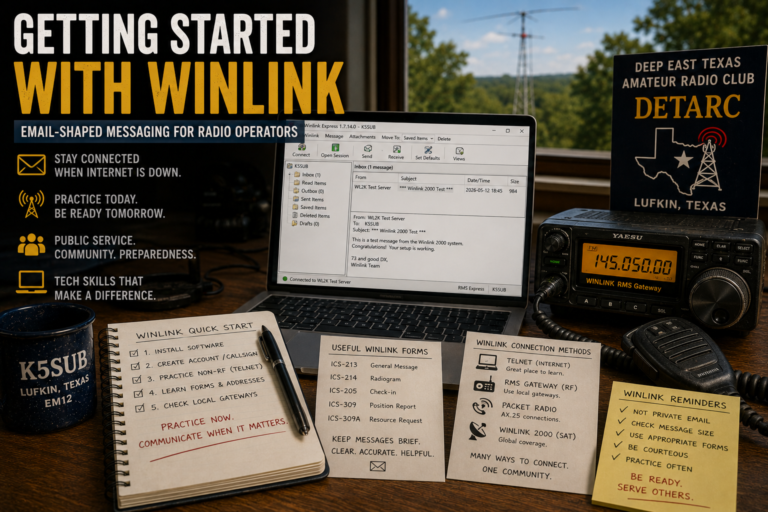
    One of amateur radio’s most practical digital services is Winlink, a worldwide radio email system that allows operators to send and receive messages without relying on traditional internet infrastructure. Winlink uses a network of radio gateways connected to the internet, allowing stations to exchange messages over HF, VHF, or UHF frequencies. During emergencies, messages can…

    Read More Winlink: Email Without the InternetContinue

  • Understanding FT8: Why This Digital Mode Became So Popular
    FT(x) | Operating | Uncategorized

    Understanding FT8: Why This Digital Mode Became So Popular

    ByDanny Butler (K5SUB) 24-June-20262-July-2026

    FT8 has become one of the most widely used digital modes in amateur radio, especially during periods of poor band conditions and low solar activity. Developed by Joe Taylor, K1JT, and the WSJT-X development team, FT8 was designed to allow reliable communication using very weak signals. Unlike traditional voice communication, FT8 exchanges are highly structured…

    Read More Understanding FT8: Why This Digital Mode Became So PopularContinue

  • Installing AllStarLink 3 on a Raspberry Pi with a SHARI Pi3U
    Technical Articles

    Installing AllStarLink 3 on a Raspberry Pi with a SHARI Pi3U

    ByDanny Butler (K5SUB) 22-June-202625-June-2026

    I recently built a new AllStarLink node using the current AllStarLink 3 distribution on a Raspberry Pi with a SHARI Pi3U radio interface. This post is not intended to be a line-by-line installation manual, because the exact screens and package versions will change over time. Instead, it is a high-level walkthrough of the process I…

    Read More Installing AllStarLink 3 on a Raspberry Pi with a SHARI Pi3UContinue

  • Why Every New Amateur Should Spend Time Listening First
    News | Operating

    Why Every New Amateur Should Spend Time Listening First

    ByDanny Butler (K5SUB) 22-June-20262-July-2026

    One of the first questions new amateur radio operators ask after receiving their license is, “What should I do now?” The temptation is often to immediately begin transmitting, making contacts, or purchasing additional equipment. While enthusiasm is one of the greatest strengths of the amateur radio community, there is considerable value in spending time listening…

    Read More Why Every New Amateur Should Spend Time Listening FirstContinue

Page navigation

Previous PagePrevious 1 2 3 4 … 7 Next PageNext
New to Ham Radio? Start Here.

QRZ Callsign Search

Upcoming Events


Latest Posts

  • How to install the DETARC Net-Logger Application on Windows.
  • Smith Charts
  • Website update
  • How To Use Net-Logger
  • Help Us Inspire the Next Generation of Amateur Radio

Archives


Categories

  • Antennas and Coax
  • Club Documents
  • Digital Modes
  • FT(x)
  • HF
  • ICS
  • Meeting Minutes
  • Member's Only
  • News
  • Operating
  • Opinion
  • POTA
  • Reference Materials
  • Technical Articles
  • Uncategorized
  • Winlink

Tag Cloud

Allmon3 AllStarLink Antennas ASL3 Contesting CW Digital Modes DX FM Getting Started HF Logging Morse Code New Operators Operating Tips Outreach POTA Propogation Raspberry Pi Repeaters SHARI Pi3U Supermon swr Testimony WSPR

© 2026 detarc.net - WordPress Theme by Kadence WP

  • Home
  • About Us
    • Who We Are
    • Leadership
    • Meetings
    • Repeater and Club Info
      • NESTxLINK Repeater Network
  • Getting Started in Ham Radio
    • Begin Your Amateur Radio Journey
    • What is Ham Radio?
    • Local Amateur Radio Testing
    • New Amateur Radio Resources
    • Help Others become Hams
  • Resources
    • DETARC PDF Library Archives
    • Antennas and Coax
    • Digital Modes
      • FT(x)
      • Winlink
    • Emergency Communications
      • ARES
      • ICS
      • RACES
    • Operating
      • HF
      • POTA
      • Satellite
      • VHF/UHF
    • Technical Articles
  • Calendar of Events
  • News
  • Member’s Only
    • Net Attendance
    • Club Documents
    • Meeting Minutes
    • Publishing Tools and Guides
      • Member Only Publishing Tools
      • Generating AI images that conform to the DETARC Visual Style Guide
      • DETARC Visual Style Guide