
What Can You Actually Do With a Technician License?
You studied. You passed the exam. You proudly received your callsign.
You programmed your new handheld, listened to the local repeater…
…and heard almost nothing.
If that describes your first few days as a licensed amateur radio operator, take heart—you are far from alone.
Many new hams quietly drift away from the hobby during their first year. Not because amateur radio is boring, but because no one ever answered the question that naturally follows the exam:
“Okay…now what?”
The Technician license isn’t the end of the journey.
It’s the key that unlocks one of the broadest technical hobbies in the world.
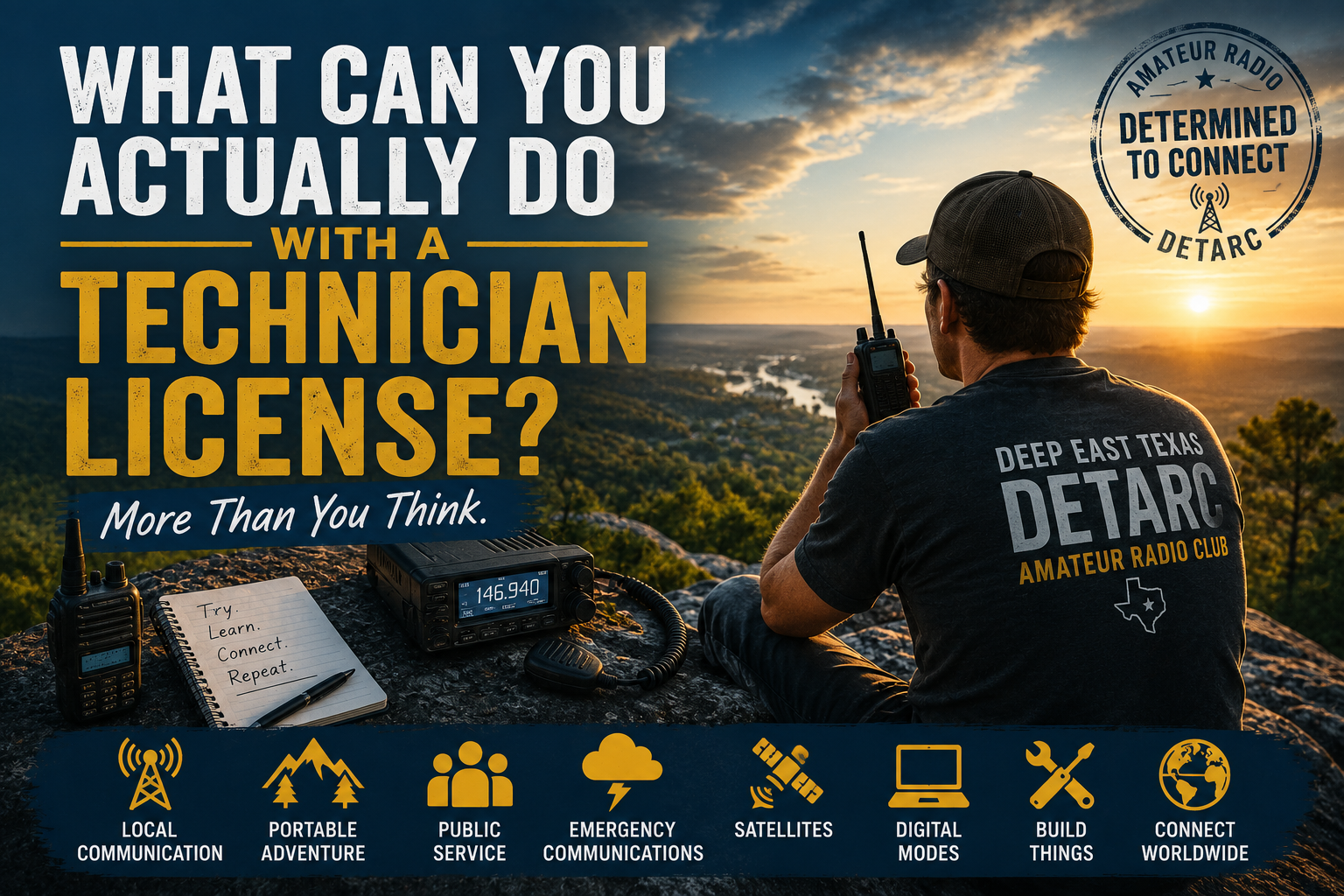
Whether you’re interested in public service, emergency communications, camping, satellites, computers, electronics, or simply meeting interesting people, there is a place for you in amateur radio.
This next series of articles will explore some of them so catch up and stay tuned.
Start Where Every Ham Starts
For most operators, the first stop is a local repeater.
A repeater is simply a radio system that receives your transmission and retransmits it from a higher location, allowing handheld radios to communicate over much greater distances.
It’s also where friendships begin.
Don’t worry if your local repeater sounds quiet. Many operators monitor while driving, working, or around the house. Sometimes all it takes is someone saying:
“K5SUB monitoring.”
to begin a conversation. (If you are in DETARC territory, you are likely to get a response from AA5HH.)
If your local club hosts a weekly net—as DETARC does—that’s one of the best places to become comfortable talking on the air.
Explore Beyond the Neighborhood
Your Technician license isn’t limited to local repeaters.
You also have privileges on the 10-meter HF band:
- SSB Phone: 28.300–28.500 MHz
- RTTY/Data: 28.000–28.300 MHz
- CW privileges on portions of 80, 40, 15, and 10 meters
When solar conditions cooperate, even a modest station can communicate hundreds—or thousands—of miles away.
Many operators are surprised to discover their first DX contact happens long before they upgrade to General.
Amateur Radio Isn’t Just Talking
Perhaps the biggest surprise for many newcomers is that voice communication is only one small part of the hobby.
You can explore:
- Winlink email over radio
- APRS position reporting
- Amateur satellites
- Parks on the Air (POTA)
- Field Day
- Portable operating
- Raspberry Pi projects
- Building antennas
- Digital voice
- Mesh networking
- Public service events
- Emergency communications
There is no “right” way to enjoy amateur radio.
That’s part of what makes it so rewarding.
Build Something
Many operators eventually discover they enjoy building almost as much as operating.
Simple projects include:
- Roll-up J-poles
- Portable go kits
- Battery boxes
- Power distribution panels
- Coax assemblies
- Portable masts
Every project teaches another piece of the RF puzzle.
Meet Remarkable People
Amateur radio brings together people from nearly every profession imaginable.
- Teachers.
- Pilots.
- Engineers.
- Truck drivers.
- Farmers.
- Students.
- Retirees.
- Veterans.
The radio becomes the common language.
One conversation often leads to another, and before long you recognize voices on the repeater like old friends.
A Word About Emergency Communications
Amateur radio has earned its reputation by helping when normal communications are unavailable or overloaded.
That doesn’t mean replacing police, fire, or EMS.
It means trained volunteers providing additional communication capabilities when communities need them most.
Learning message handling, portable power, Winlink, and field operations prepares you to serve others while developing practical skills you’ll use for years.
Choose Your Own Adventure (Technician Edition)
Now the fun begins.
Choose the path that sounds most interesting and keep exploring. (Links will become available as the articles are published in this series.)
📻 Adventure 1: I Want to Meet Local Operators
- Getting Started on the DETARC Repeaters
- Understanding Repeaters
- Understanding PL Tones, Offsets, and IDs
- What If Nobody Answers?
- Beyond Your Local Repeater
- Choosing Your First Mobile Radio
🌎 Adventure 2: I Want to Talk Around the World
- Technician HF: Your First DX Contact on 10 Meters
- Understanding HF Propagation
- Solar Weather Without the Scary Science
- Building Your First HF Antenna
- Choosing Your First HF Radio
- Logging Contacts
- QSL Cards in 2026
💻 Adventure 3: I Like Computers
- Getting Started with Winlink
- APRS for Beginners
- Mesh Networking Explained
- Digital Voice (DMR, Fusion & D-STAR)
- Raspberry Pi Projects for Hams
- Software Every Ham Should Know
🛰 Adventure 4: I Want to Experiment
- Working Your First Amateur Satellite
- Parks on the Air (POTA)
- Building Your First Go Kit
- Build Your First Antenna
- Field Day Explained
- Where Do You Go From Here? (General Class and Beyond)
🌲 I Want to Operate Outdoors
- Parks on the Air for Beginners
- Summits on the Air for Beginners
🚨 I Want to Help During Emergencies
- Building Your First Go Kit
- Getting involved with RACES/ARES
- Track and report weather as a skyward operator
Where Should You Start?
If you’re unsure which path to take, here’s my recommendation:
- Learn your local repeaters.
- Check into the weekly DETARC net.
- Make a few local friends.
- Then branch out into whatever excites you most.
You’ll learn more from one evening spent talking with experienced operators than from hours of reading manuals.
One Final Thought
The Technician license isn’t permission to own a radio.
It’s permission to explore.
Some operators spend their lives chasing DX.
Others build antennas.
Some volunteer during disasters.
Others hike to mountain summits with tiny radios in their backpacks.
There isn’t a single correct destination.
There are only adventures waiting to be chosen.
So…
What sounds interesting to you?
