
What Does “73” Actually Mean?
One of the first things a new amateur radio operator notices is that conversations often end with a simple number:
“Thanks for the contact. 73!”
If you’re new to the hobby, you might wonder if you missed a chapter in the license manual. Why 73? Why not 72 or 75?
As it turns out, this little number has a fascinating history that reaches back to the earliest days of telegraphy.
More Than Just a Number
In amateur radio, 73 simply means “Best regards.”
It’s a friendly way to end a conversation, whether you’re chatting on a local repeater, making contacts across the world on HF, or sending messages through digital modes like FT8 or Winlink.
Think of it as the radio equivalent of saying:
- Take care.
- Have a great day.
- God bless.
- See you next time.
It closes a conversation on a positive note.
Where Did 73 Come From?
Long before amateur radio existed, telegraph operators were looking for ways to send common phrases quickly over Morse code.
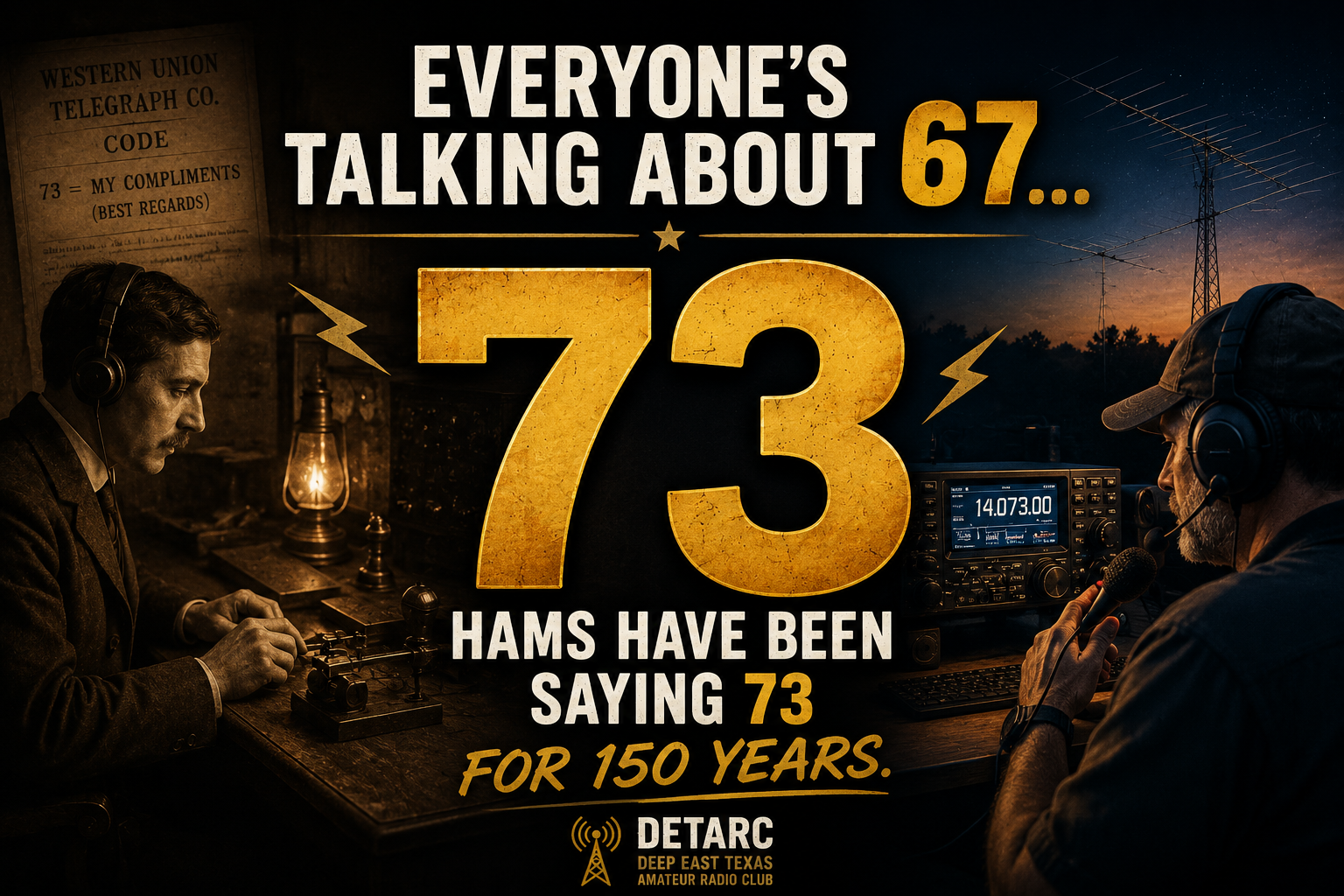
During the mid-1800s, Western Union and other telegraph companies developed numeric codes that represented frequently used messages. Instead of sending several words, an operator could send just a number.
One of those numbers was 73, which originally meant something like:
“My compliments.”
Over time its meaning evolved into:
“Best regards.”
When amateur radio grew out of the telegraph tradition, many of those numeric codes came along for the ride. More than a century later, 73 is still one of the most recognizable traditions in the hobby.
Why Not Just Say “Goodbye”?
You certainly can.
But amateur radio has always had its own culture and traditions.
Just as sailors have nautical expressions and pilots have aviation phraseology, radio operators have developed their own shorthand that saves time and builds camaraderie.
Using “73” connects today’s operators with generations of telegraphers and radio amateurs stretching back over 150 years.
Common Radio Numbers
73 isn’t the only number you’ll hear.
| Number | Meaning |
|---|---|
| 73 | Best regards |
| 88 | Love and kisses (traditionally exchanged between YLs—female operators—or among close friends) |
| 51 | Best wishes (rarely used today) |
Of these, 73 is by far the most common and appropriate for nearly every contact.
“73s” Is Like Saying “Best Regardses”
Here’s a fun bit of amateur radio trivia.
Since 73 already means “best regards,” adding an “s” to make “73s” is technically incorrect.
It’s a little like saying:
“Best regardses.”
Likewise, writing “73’s” with an apostrophe isn’t correct either—the apostrophe implies possession, as though 73 owns something.
Will anyone become upset if you say “73s”? Probably not.
Will some experienced operators quietly cringe? Absolutely.
The traditional and correct sign-off is simply:
73
Nothing more.
How You’ll Hear It
On voice:
“Thanks for the QSO. 73!”
In Morse code:
--... ...--
In an email:
73,
Danny
K5SUB
On digital modes:
TU 73
Short, simple, and universally understood.
One Small Number, One Big Tradition
One of the things that makes amateur radio special is its rich history. Every time you sign off with “73,” you’re participating in a tradition that began with telegraph operators tapping brass keys in the nineteenth century.
Not every operator uses every bit of radio jargon—and that’s perfectly okay. But learning the language of the hobby is part of becoming comfortable on the air.
So the next time someone ends a contact with “73,” you’ll know exactly what they mean.
And now you can confidently reply:
73!
Did You Know?
Some operators jokingly say that 72 is reserved for QRP (low-power) operators because it’s one better than 73. The joke originated with the QRP Amateur Radio Club International, and while you’ll occasionally hear “72” among dedicated QRP enthusiasts, 73 remains the standard sign-off throughout amateur radio. It is, however, one of those uniquely ham-radio jokes that tends to get better—or worse—the longer you’ve been licensed.

One Comment