
Getting Started on the DETARC Repeaters
“The radio is programmed… now what?”
You studied.
You passed your Technician exam.
A few days later, your new handheld arrives.
You charge the battery, carefully program the local repeater, turn the volume up…
…and wait.
Five minutes pass.
Ten minutes.
Nothing.
You begin wondering if you’ve programmed something incorrectly.
Maybe nobody uses amateur radio anymore.
Maybe everyone is on some secret frequency no one told you about.
Maybe you’ve made an expensive mistake.
Here’s the good news.
Almost every amateur radio operator has experienced this exact moment.
The silence isn’t because amateur radio is dead.
It’s because repeaters don’t work like a telephone.
They work more like a front porch.
People are listening.
They’re simply waiting for someone to say hello.
That someone can be you.
What Is a Repeater?
Imagine trying to shout across town.
Your handheld radio can only transmit so far because it’s limited by both power and your antenna’s height.
Now imagine someone standing on a 500-foot tower repeating everything you say.
Suddenly, dozens—or even hundreds—of people can hear you.
That’s exactly what a repeater does.
It listens on one frequency and instantly retransmits your signal on another from a much higher antenna.
Instead of talking radio-to-radio, you’re talking radio-to-repeater.
The repeater does the heavy lifting.
Meet the DETARC Repeater System
One of the greatest strengths of the Deep East Texas Amateur Radio Club isn’t just having a repeater—it’s maintaining an entire communications network that serves the region.
Whether you’re around Lufkin, Alto, Shelby County, or traveling across Deep East Texas, there’s a good chance a DETARC repeater is nearby.
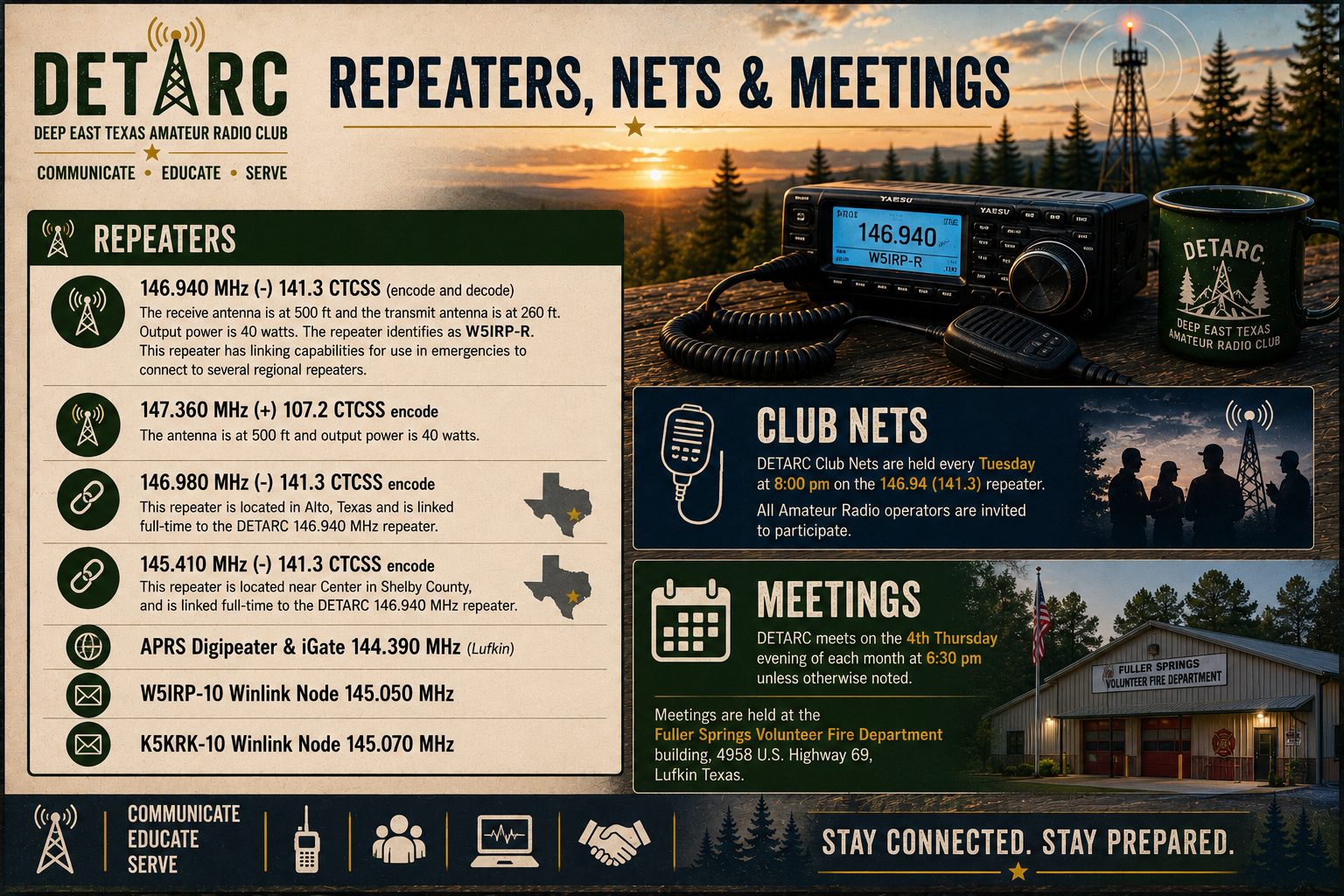
W5IRP-R — 146.940 MHz (-)
This is the repeater you’ll probably use the most.
Frequency: 146.940 MHz (-600 kHz offset)
CTCSS: 141.3 Hz (encode and decode)
The receive antenna sits approximately 500 feet above ground, while the transmit antenna is mounted around 260 feethigh.
With 40 watts of output power and excellent elevation, it provides impressive regional coverage.
During emergencies, this repeater can be linked to other regional systems, extending communications well beyond the local area.
If someone says “meet me on .94,” this is almost certainly the repeater they’re referring to.
147.360 MHz (+)
This machine provides additional local coverage.
- Positive offset
- 107.2 Hz CTCSS encode
- 40 watts output
- Approximately 500-foot antenna height
Many members monitor both repeaters throughout the day.
Linked Repeaters
DETARC also operates linked repeaters that expand communications across Deep East Texas.
Alto
146.980 MHz (-)
141.3 Hz CTCSS
Located in Alto, this repeater is linked full-time to the primary 146.940 repeater.
Shelby County
145.410 MHz (-)
141.3 Hz CTCSS
Located near Center in Shelby County and linked full-time to 146.940 MHz.
From the operator’s perspective, it feels like one larger repeater system.
Talk into one.
Everyone hears you.
More Than Voice
The DETARC infrastructure doesn’t stop with repeaters.
Members also maintain:
- APRS Digipeater & iGate on 144.390 MHz
- W5IRP-10 Winlink RMS on 145.050 MHz
- K5KRK-10 Winlink RMS on 145.070 MHz
As your interests grow into GPS tracking, digital messaging, emergency communications, or Winlink email, these systems are already waiting for you.
“But It’s So Quiet…”
This is probably the number one question every new ham asks.
“Why doesn’t anyone ever talk?”
Because most people monitor instead of leaving the speaker blasting all day.
Operators often have the radio quietly monitoring while they:
- Drive to work
- Mow the lawn
- Work in the garage
- Sit in their home office
- Cook dinner
Many are listening.
Few are talking.
Until someone keys up.
Your First Transmission
Here’s a secret.
It doesn’t have to be clever.
It doesn’t have to be important.
It doesn’t even have to be a conversation.
Simply key the microphone and say:
“K5SUB monitoring.” (substitute your call sign)
That’s it.
Those two words tell everyone listening:
“I’m available if anyone wants to chat.”
Experienced operators recognize this immediately.
Someone will often answer with:
“K5SUB, this is W5ABC. Good afternoon.”
Congratulations.
You just made your first contact.
What If Nobody Answers?
Nothing.
Nothing bad happens.
You haven’t embarrassed yourself.
You haven’t violated protocol.
You simply caught everyone at a busy moment.
Try again later.
Morning commutes.
Lunch.
Evening commutes.
Weekend mornings.
You’ll quickly discover patterns.
Join the Weekly DETARC Net
If there’s one recommendation we can make to every new operator, it’s this:
Check into the weekly club net.
Every Tuesday evening at 8:00 PM, members gather on:
146.940 MHz
CTCSS 141.3 Hz
The weekly net is designed for exactly the kind of operator reading this article.
You’ll hear familiar voices.
Learn names.
Practice using your callsign.
Hear announcements.
Meet experienced operators who genuinely enjoy helping newcomers.
Don’t worry if you’ve never checked into a net before.
The Net Control Station will explain exactly what to do.
Simply wait for a pause and respond when called.
Nobody expects perfection.
Everyone remembers being new.
Your First Week as a DETARC Operator
Here’s a challenge.
Instead of just listening, spend one week becoming an active operator.
Monday
Program every DETARC repeater into your radio.
Tuesday
Check into the weekly net.
Wednesday
Listen during your drive home.
Thursday
Attend the monthly club meeting if it’s the fourth Thursday.
Meet the voices you’ve been hearing.
Friday
Call:
“Your callsign monitoring.”
See what happens.
Weekend
Take your handheld to a local park.
Try different repeaters.
Experiment.
The goal isn’t to become an expert.
The goal is to become comfortable.
Common Beginner Mistakes
Waiting for Someone Else
Everyone is waiting.
Be the first person to key up.
Talking Too Fast
Relax.
Normal conversation is perfectly acceptable.
Apologizing Constantly
You don’t need to apologize for being new.
Every experienced ham started exactly where you are.
Fear of “Doing It Wrong”
Unless you’re intentionally causing interference or ignoring FCC rules, you’re probably doing just fine.
The amateur radio community is remarkably patient with newcomers who are making an honest effort.
Beyond the Repeater
One conversation often leads to another.
Soon you’ll hear members discussing:
- Parks on the Air
- Winlink
- APRS
- Emergency exercises
- Building antennas
- Satellite contacts
- Digital modes
- Portable operating
- Club events
That’s how many lifelong amateur radio journeys begin.
Not with expensive equipment.
Not with a perfect station.
But with a simple conversation on a local repeater.
One Final Thought
A repeater is much more than a machine on a tower.
It’s where friendships begin.
It’s where mentors become “Elmers.”
It’s where nervous new Technicians become confident operators.
And it’s where a community stays connected long after the meeting ends.
So don’t wait for someone else to make the first call.
Pick up the microphone.
Take a breath.
Press the push-to-talk button.
Say your callsign.
The rest will come naturally.
Choose Your Next Adventure
Now that you’ve learned how to get on the air locally, where would you like to go next?
- Understanding Repeaters: What’s Happening Behind the Scenes?
- Making Your First QSO Without Being Nervous
- Checking Into Your First Net
- Technician HF: Your First DX Contact on 10 Meters
- Getting Started with Winlink
- Working Your First Amateur Satellite
- Build Your First Antenna
