
Choosing Your First Handheld (HT)
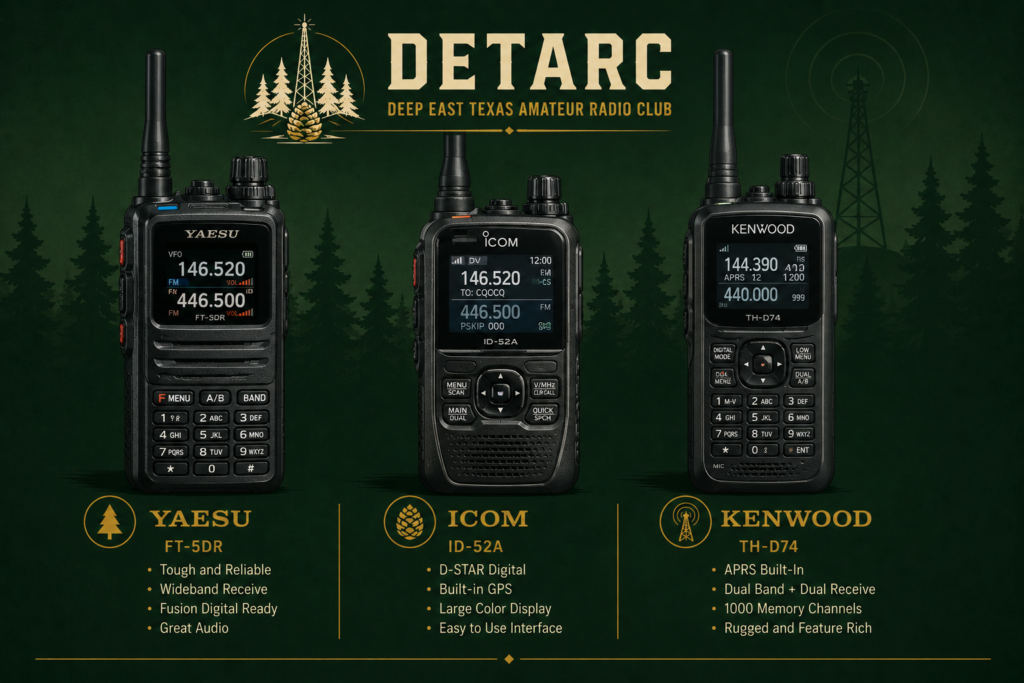
For most newly licensed Technician operators, a handheld transceiver—commonly called an HT—is the best place to start. It’s affordable, portable, and capable of everything you’ll need to learn the fundamentals of amateur radio.
But not all handhelds are created equal.
Some cost less than a family dinner. Others cost several hundred dollars. The question isn’t, “What’s the best HT?” It’s “Which HT is the best fit for where you are in the hobby?”
What Can an HT Do?
A dual-band handheld allows you to:
- Check into local club nets
- Talk through repeaters
- Communicate simplex with nearby operators
- Participate in public service events
- Carry a radio during emergencies
- Listen to weather alerts
- Learn proper operating procedures
For many hams, their handheld becomes the radio that goes everywhere.
Before You Buy
Consider these questions:
- Will this be your only radio for a while?
- Will you carry it daily or leave it at home?
- Are local repeaters analog or digital?
- Do you enjoy learning new technology?
- How much programming are you comfortable doing?
The answers may influence which radio makes the most sense.
Budget Tier (Under $50)
Baofeng UV-5R
The UV-5R is probably the most well-known amateur radio in the world.
Pros
- Extremely inexpensive
- Huge online community
- Lots of accessories
- Easy to replace if damaged
Cons
- Mediocre receiver performance
- Confusing menus
- Variable quality control
- Stock antenna is only average
This radio has introduced thousands of people to amateur radio, but it can also be frustrating for beginners because of its menu system and receiver performance.
Best for: Someone on a very tight budget who simply wants to get on the air.
Best Value ($80–150)
Yaesu FT-65R
If you’re able to spend a little more, this is one of the easiest recommendations.
Why We Like It
- Excellent receiver
- Better audio
- Rugged construction
- Simple operation
- Good battery life
It doesn’t have every modern feature—but that’s part of its appeal.
It simply works.
Best for: Most new Technician operators.
Yaesu FT-60R
Although introduced many years ago, the FT-60 remains one of the most respected handhelds ever made.
Why?
Because it has earned a reputation for reliability.
Many experienced operators still carry one today.
Digital-Capable Radios ($150–250)
Eventually you’ll hear someone mention DMR, Fusion, D-STAR, or other digital modes.
If your local repeaters support digital voice, you might consider starting with one of these.
Yaesu FT-70DR
Supports:
- Analog FM
- Yaesu System Fusion (C4FM)
Excellent if your club uses Fusion repeaters.
Icom ID-52A
Premium handheld featuring:
- D-STAR
- GPS
- Bluetooth
- Excellent receiver
Outstanding—but probably more radio than most beginners need.
What About Chinese Brands?
Today there are many capable manufacturers besides the traditional “Big Three.”
Companies such as:
- AnyTone
- Wouxun
- BTECH
- Radioddity
offer excellent value, particularly if you’re interested in digital modes like DMR.
Quality has improved dramatically over the last decade.
The Most Important Upgrade Isn’t the Radio
Many new operators immediately start shopping for a more expensive radio.
Instead, consider upgrading the antenna.
Replacing the stock “rubber duck” antenna with a quality aftermarket antenna can noticeably improve both transmit and receive performance.
Better yet, use an external antenna at home.
Even a modest HT connected to a rooftop antenna can perform surprisingly well.
Programming Your HT
Most modern radios can be programmed from the keypad.
You’ll quickly discover why most operators don’t.
Programming software makes life much easier.
The most popular options are:
- CHIRP (free, supports many radios)
- Manufacturer programming software
- RT Systems software (commercial, polished, easy to use)
If your club offers programming assistance, take advantage of it.
Accessories Worth Buying
Instead of spending another $200 on a fancier radio, consider adding:
- Spare battery
- Better antenna
- Speaker microphone
- USB programming cable
- Protective case
- Car charger
These accessories often improve the operating experience more than upgrading radios.
Common Beginner Mistakes
Buying only because it’s cheap
The least expensive radio isn’t always the least expensive experience.
Ignoring the local repeater landscape
If your area primarily uses Fusion or D-STAR, buying an analog-only radio may limit your options.
Expecting handheld range to match a cell phone
Handheld radios typically transmit around 5 watts.
Range depends heavily on:
- Terrain
- Antenna height
- Buildings
- Repeater availability
Don’t judge your radio by one unsuccessful simplex contact.
Our Recommendations
Budget Pick
Baofeng UV-5R
If your goal is simply getting on the air for the lowest possible cost.
Best Overall Value
Yaesu FT-65R
Reliable, easy to use, and likely to serve you well for years.
Best Long-Term Investment
Yaesu FT-60R
A radio you’ll probably still own a decade from now.
Best Digital Starter
Yaesu FT-70DR
If your local repeaters use System Fusion.
Final Thoughts
Remember that an HT is a starting point, not the finish line.
As you spend more time on the air, you’ll discover what aspects of amateur radio excite you most. Maybe you’ll become interested in emergency communications, satellite operations, hiking with Summits on the Air (SOTA), digital voice, or eventually HF.
Your first handheld is simply the tool that gets you involved in the hobby.
That’s far more important than buying the “perfect” radio.
Looking Ahead
Once you’ve become comfortable operating with an HT, your next upgrade will often be one of these:
- A mobile radio for significantly greater range and power.
- A home base station with an outdoor antenna.
- An HF station after earning your General Class license.
No matter which path you take, the skills you learn with your first handheld will carry over to every radio you own in the future.

One Comment