
Choosing Your First Radio
You’ve passed your Technician exam. Congratulations! Now comes the question every new amateur radio operator asks:
“What radio should I buy?”
The good news is that there isn’t a single “correct” answer. The bad news is that there are hundreds of radios on the market, each promising to be the perfect first rig.
The best first radio isn’t necessarily the one with the most features or the highest price tag—it’s the one that matches how you plan to use amateur radio.
The ARRL recommends thinking first about the kinds of operating you want to do before choosing a radio, rather than simply buying whatever is popular.
Start by Asking Yourself…
Think about these questions:
- Will I mostly talk through local repeaters?
- Do I want a radio I can carry everywhere?
- Will I spend a lot of time in my vehicle?
- Do I want a station at home?
- Am I interested in emergency communications?
- Do I expect to upgrade to General soon?
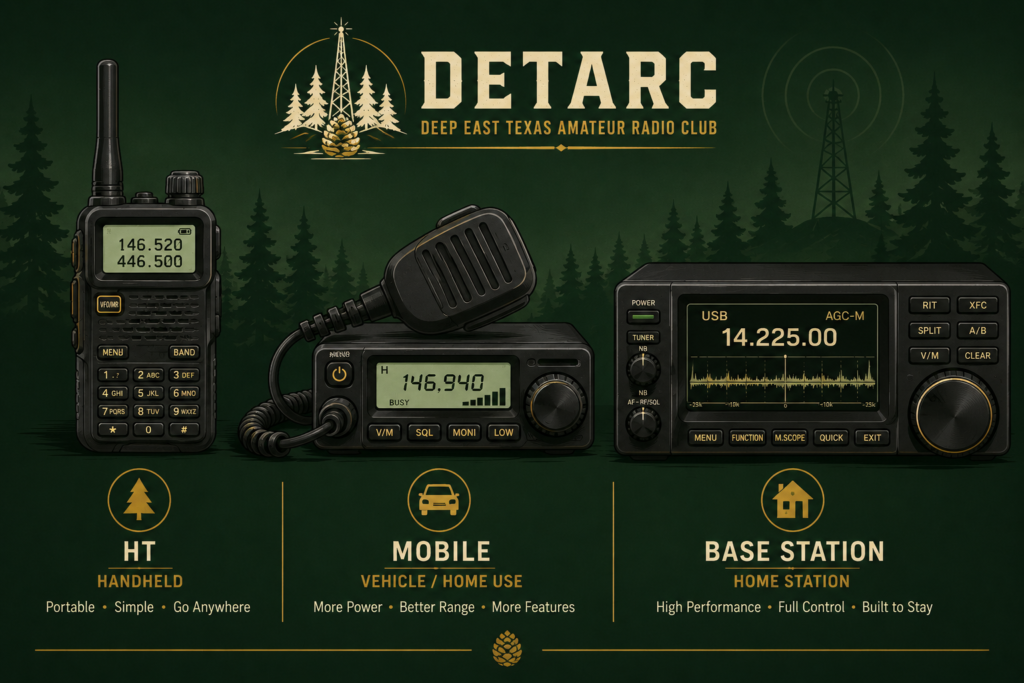
Your answers will naturally point you toward one of three common categories.
Option 1: Handheld (HT)
Best for:
- New operators
- Club meetings
- Public service events
- Local repeaters
- Emergency kits
A handheld (“HT”) is the radio most new hams purchase first.
They’re inexpensive, portable, battery powered, and can easily access local repeaters. They’re also great for learning operating procedures before investing in larger equipment.
Advantages
- Lowest cost
- Extremely portable
- No installation required
- Perfect for learning
Limitations
- Lower transmit power (typically 5 watts)
- Small antenna limits range
- Indoor performance can sometimes be disappointing
Example Radios
- Baofeng UV-5R (ultra-budget)
- Yaesu FT-65R (excellent entry-level quality)
- Yaesu FT-70DR (adds digital capability)
- Yaesu FT-60R (a long-time favorite known for durability)
Community consensus tends to favor spending a little more for a quality HT such as the FT-60R or FT-65R if your budget allows, rather than the very cheapest radios.
→ Read next: Choosing Your First Handheld (HT)
Option 2: Mobile Radio
Best for:
- Daily commuters
- Storm spotters
- ARES/RACES volunteers
- Anyone wanting significantly better performance
Despite the name, a mobile radio doesn’t have to stay in your vehicle.
Many operators use a mobile transceiver as their first home station by connecting it to a 13.8-volt power supply and an outside antenna.
With 25–75 watts of power, a mobile radio can dramatically outperform a handheld.
Advantages
- Much greater range
- Better receiver
- Easier to operate while driving
- Can double as a home station
Limitations
- Requires installation
- Needs an external antenna
- Requires a power supply if used indoors
Example Radios
- Yaesu FTM-200DR
- Icom ID-5100A
- AnyTone AT-779UV
- BTECH UV-50X2
→ Read next: Choosing Your First Mobile Radio
Option 3: Base Station
Best for:
- Operators who primarily operate from home
- Those planning to earn their General license soon
- Building a permanent station
A base station is simply a radio installed in your home with a permanent antenna and power supply.
For Technician operators, this may be a VHF/UHF radio used on local repeaters. If you expect to upgrade to General soon, many operators choose an HF radio that also includes VHF/UHF capability, allowing it to grow with them.
Advantages
- Best audio quality
- Highest performance
- Large display and controls
- Easy to connect accessories
Limitations
- Highest initial cost
- Requires an antenna installation
- Not portable
Example Radios
- Icom IC-7100
- Yaesu FT-991A
- Icom IC-7300 (HF only; ideal after upgrading to General)
- Yaesu FT-891 (compact HF station)
→ Read next: Choosing Your First Base Station
What About Cheap Radios?
Many new operators notice handhelds selling for under $30.
They certainly work—and thousands of hams started with one—but inexpensive radios often involve compromises:
- Receiver performance
- Audio quality
- Programming ease
- Build quality
- Long-term reliability
There’s nothing wrong with starting on a tight budget, but remember that the antenna often makes a bigger difference than spending another $100 on the radio.
Don’t Forget the Antenna
One of the biggest surprises for new hams is this:
A good antenna usually improves your station more than a more expensive radio.
A modest radio connected to a quality outdoor antenna will often outperform a premium handheld using its stock rubber antenna.
If your budget is limited, don’t spend all of it on the radio.
Our Recommendation
For most new Technician operators, we’d suggest one of these paths:
| Your Goal | Recommended Choice |
|---|---|
| Lowest cost | Entry-level handheld |
| Best overall value | Quality dual-band handheld |
| Serious repeater use | 50-watt mobile radio |
| Planning to upgrade to General soon | HF-capable base station |
Remember: your first radio probably won’t be your last. Nearly every ham eventually owns several radios, each serving a different purpose.
The important thing is getting on the air, joining local nets, participating in club activities, and gaining experience. Once you’ve spent a few months operating, you’ll have a much better idea of what your second radio should be.
Happy operating, and we’ll hear you on the air!
Additional Resources
- ARRL: Buying Your First Radio
- ARRL: Technician License Overview
Manufacturer Product Pages
- Yaesu Amateur Radios
- Icom America Amateur Products
- Kenwood Amateur Radio
- AnyTone Amateur Radios
- BTECH Amateur Radios
Choosing Your First Radio is intended as an overview. In the articles linked above, we’ll dive much deeper into each category, including budget recommendations, antennas, programming software, accessories, and common mistakes to avoid.

One Comment