
Understanding Repeaters
“Wait… How Can Everyone Hear Me?”
One of the first mysteries every new ham encounters goes something like this:
You key your handheld radio from your driveway in Lufkin.
A few seconds later, someone answers from twenty or thirty miles away.
You look down at your radio and think:
“There’s no way this little five-watt handheld just did that.”
You’re right.
It didn’t.
The repeater did.
Understanding repeaters is one of the biggest “light bulb moments” in amateur radio. Once you understand what they’re doing, things like offsets, PL tones, linked repeaters, and even emergency communications suddenly make a lot more sense.
Let’s pull back the curtain.
Think of a Repeater Like a Mountaintop Friend
Imagine you and a friend are standing in opposite valleys.
You can’t hear each other because hills and trees are in the way.
Now imagine a third friend standing on top of a mountain.
He hears everything you say.
He immediately shouts it toward the other valley.
Suddenly, both of you can communicate.
That’s essentially what a repeater does.
Instead of a person on a mountain…
It’s a radio on a tower.
Why Height Beats Power
Many new operators assume bigger radios equal longer range.
Sometimes they do.
But in VHF and UHF communications, height usually matters more than power.
Think about standing in a football stadium.
If you’re on the field, your view is limited.
Climb to the top row and suddenly you can see everything.
Radio waves behave much the same way.
Your handheld may only transmit five watts, but if it can “see” a repeater antenna mounted hundreds of feet in the air, that repeater can often hear you perfectly.
That’s why the DETARC primary repeater performs so well.
The receive antenna sits approximately 500 feet above ground, giving it an outstanding view across Deep East Texas.
Why Doesn’t the Repeater Talk Over Me?
Here’s where things get clever.
A repeater is actually listening and transmitting at the same time.
If it tried doing both on the same frequency, it would simply hear itself forever.
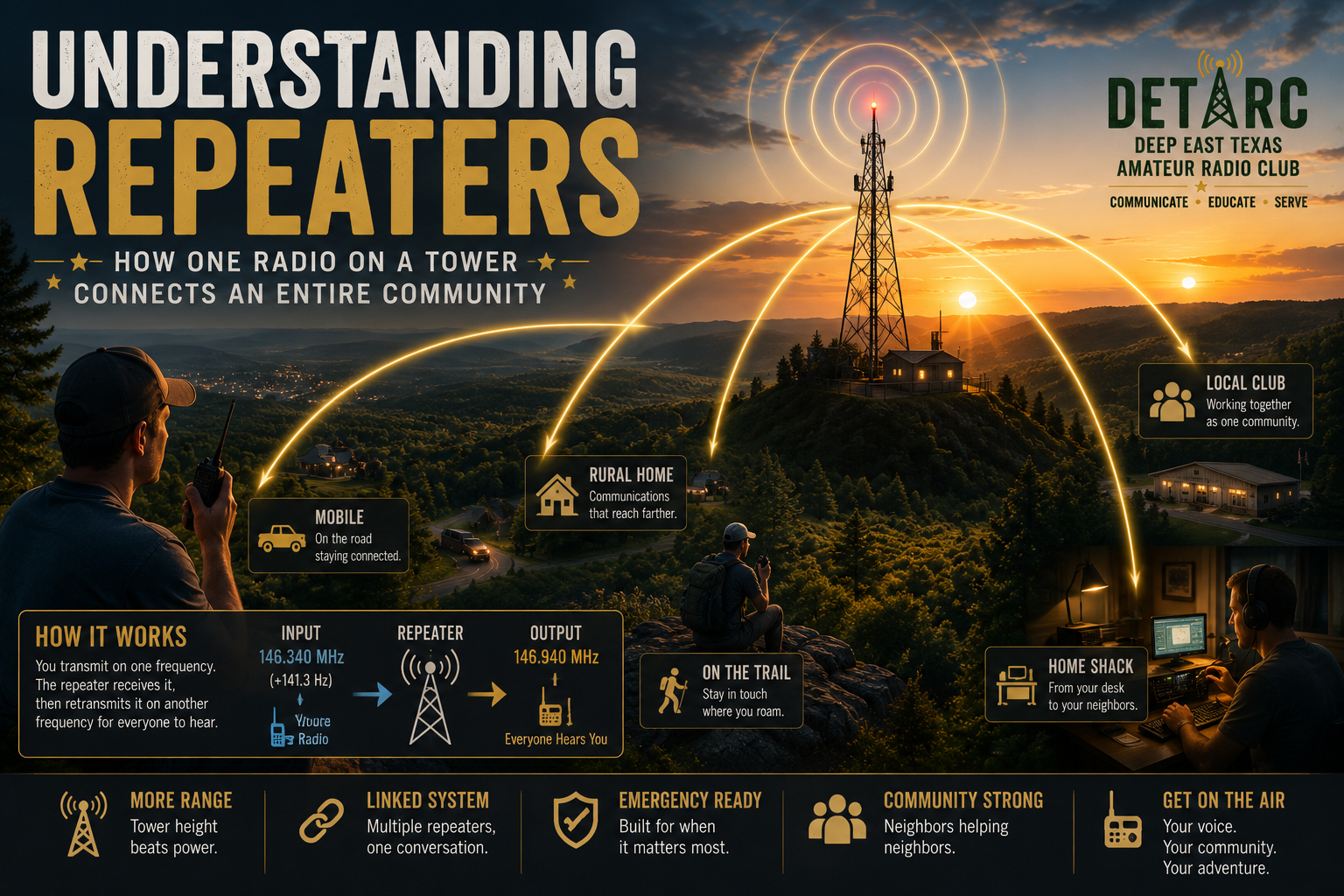
Instead, every repeater uses two frequencies.
One frequency for listening.
One frequency for transmitting.
When you key your microphone:
- Your radio transmits on the repeater’s input frequency.
- The repeater hears you.
- It instantly retransmits your audio on its output frequency.
- Everyone listening hears the repeated transmission.
The delay is so short it feels instantaneous.
What Is an Offset?
You’ve probably programmed something like this:
146.940 MHz
Offset:
–600 kHz
What does that actually mean?
The repeater is transmitting to everyone on 146.940 MHz.
But it isn’t listening there.
It’s listening 600 kHz lower, on 146.340 MHz.
Fortunately, modern radios handle this automatically.
When you press PTT, your radio quietly shifts frequencies.
When you release it, it jumps back.
You never notice.
What’s That Beep? Understanding PL Tones
Imagine you live in an apartment building.
You don’t want the front door opening every time someone jingles their keys.
Instead, everyone receives a unique key.
PL tones work the same way.
Your radio quietly transmits a low-frequency tone along with your voice.
The repeater listens for that specific tone.
If it hears the correct one…
It opens.
If not…
It politely ignores the transmission.
For the primary DETARC repeater, that tone is:
141.3 Hz
You never hear it.
The repeater does.
One Repeater… or Many?
One of the coolest things about the DETARC system is that several repeaters are linked together.
That means someone talking through the Alto repeater can be heard on the Lufkin repeater.
Likewise, someone near Center can participate in the exact same conversation.
To the operator, it feels like one enormous repeater spread across Deep East Texas.
Behind the scenes, several repeaters are working together.
It’s a little like multiple speakers connected to the same microphone.
Why Linked Repeaters Matter
Linked systems become especially valuable during:
- severe weather
- public events
- emergency communications
- regional nets
Instead of trying to coordinate several independent repeaters, everyone can communicate through one connected network.
The DETARC primary repeater also has emergency linking capability that can connect with additional regional systems when needed.
That’s one reason repeaters remain an important part of emergency communications today.
What Happens When You Key the Microphone?
Let’s follow one transmission.
Danny keys his handheld in Lufkin.
↓
His radio transmits on 146.340 MHz while sending a 141.3 Hz PL tone.
↓
The repeater hears the signal.
↓
It immediately retransmits everything on 146.940 MHz.
↓
The linked repeaters in Alto and Shelby County also rebroadcast the transmission.
↓
Operators across much of Deep East Texas hear the conversation.
All of that happens in a fraction of a second.
Pretty amazing for a five-watt handheld.
What If I Can’t Reach the Repeater?
Several things affect whether a repeater hears you:
- Buildings
- Trees
- Hills
- Your antenna
- Your location
- Your battery voltage
- Whether you’re indoors or outdoors
Sometimes simply walking outside or standing near a window makes the difference.
Repeaters Are More Than Machines
A repeater isn’t just equipment.
It’s where clubs stay connected.
It’s where new operators find mentors.
It’s where weather reports are shared.
It’s where friendships begin.
Without repeaters, many amateur radio clubs simply wouldn’t exist in the way they do today.
Did You Know?
Many repeaters—including DETARC’s primary machine—can identify themselves automatically using Morse code every few minutes.
That’s why you occasionally hear a short burst of beeps during quiet periods.
The repeater is simply announcing its callsign, just like FCC rules require.
No, you don’t have to know Morse code to use the repeater.
Common Beginner Questions
“Can I damage the repeater?”
No.
Assuming you’ve programmed the correct frequency and tone, ordinary operation won’t hurt anything.
“Do I need a powerful radio?”
Not necessarily.
Many operators regularly access the DETARC repeaters using nothing more than a five-watt handheld.
“Can I just say ‘monitoring’?”
Absolutely.
That’s one of the most common—and least intimidating—ways to start a conversation.
“What if I make a mistake?”
Congratulations.
You’re officially doing amateur radio.
Every experienced operator has made plenty.
What’s Next?
Now that you understand how repeaters work…
It’s time to actually use one.
Your next adventure:
➡ Making Your First Contact
You’ll learn exactly what to say, how to say it, and why your first QSO is probably much easier than you think.
