

Antenna Interactions, Continued
This is a short followup to my previous article on antenna interactions. My original plan was to mount two wire antennas on a sidearm on the tower. The first is an 80M / 60M fan dipole mounted in an inverted vee configuration and the second is an 80M EFHW mounted as a sloper. I have previously had good success using 80M EFHW antennas mounted horizontally using trees or a push pole bracketed to the garage as supports. The objective of using an EFHW was to have a more omnidirectional multi-band antenna for contesting so I did not have keep “swinging the beam”.
In the previous article, we saw that when the two antennas were mounted parallel to one another both performed very poorly. When the EFHW was turned perpendicular to the dipole, the EFHW still performed poorly, but the dipole showed a perfectly acceptable SWR curve. A very unexpected result was that the EFHW resonant frequency in the 80M band was not affected by shortening the antenna.
In my next series of tests, I tried orienting the EFHW perpendicular to the dipole, but with the feedpoint near the ground instead near the dipole. First, I re-analyzed the dipole without the EFHW to see how it compared to previous measurements. Figure 1 shows the previous scan (December 2023, in red) and the current scan (February 2024, in green). As you can see, the SWR curve changed very little over the two-month period. Since the SWR minimum went up slightly, the change is not due to the antenna wire stretching. The difference is probably due to ground conductivity changes with all of the winter rains in January and February.
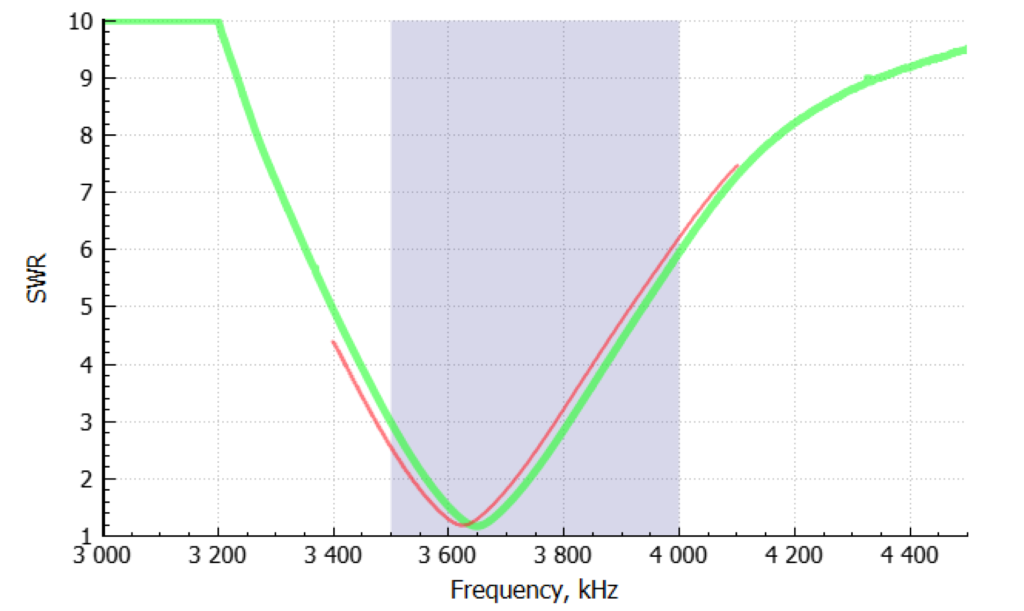
Figure 1: SWR curves for 80M Dipole in December and February
Figure 2 shows SWR curves for the dipole antenna without (green) and with (red) the EFHW mounted with the feedpoint near the ground and well away from the tower. The SWR minimum shifted to a slightly higher frequency and the SWR remained essentially the same. An odd dip and hump appeared just below the band resulting in a noticeably poorer SWR in the lower portion of the 80M band. Overall, the dipole is still perfectly usable on the 80M band and could be adjusted as desired for the lower or upper parts of the band. Figure 3 shows that the impact of the EFHW was only on 80M with the 60M dipole completely unaffected.
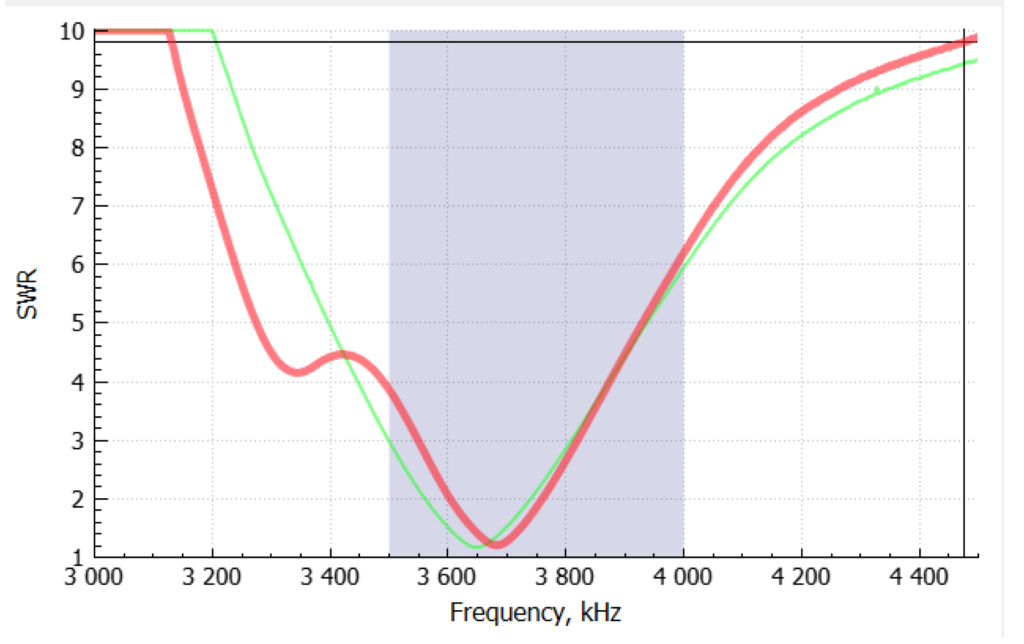
Figure 2: SWR curves for 80M Dipole Without EFHW (green) and With EFHW (red)
I made SWR curve measurements for the EFHW. My analyzer can only save graphs if connected to a PC. Since the EFHW feedpoint was away from the tower, I could not connect it to the coax into the shack. I did not take my laptop out into the pasture with me for the measurements. (Since the dipole was on the tower antenna switch, I was measuring it in the shack with the analyzer connected to the laptop.) The EFHW curves showed an SWR minimum below the 80M band because I cut it long. However, again adjusting the length of the EFHW did not move the SWR minimum.
At this point, I am at a loss to explain the results for the EFHW. I decided that it was not worth anymore time to try and solve this puzzle. This is not a very satisfying conclusion to these articles, but I have contacts to make and my other antennas work quite well. So I decided to cut my losses at this point. If anybody has any ideas on what the problem with EFHW could be, please let me know and lets discuss your ideas.
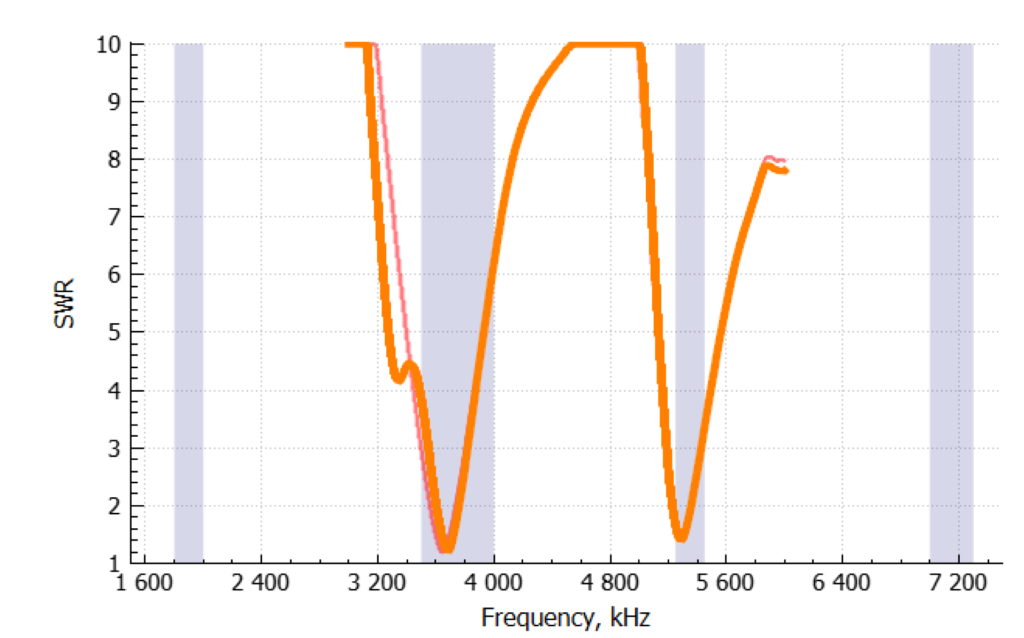
Figure 3: SWR curves for 80M / 60M Dipole Without EFHW (green) and With EFHW (red)
Source PDF: 202404 – Antenna Interactions continued
