
Choosing Your First Base Station
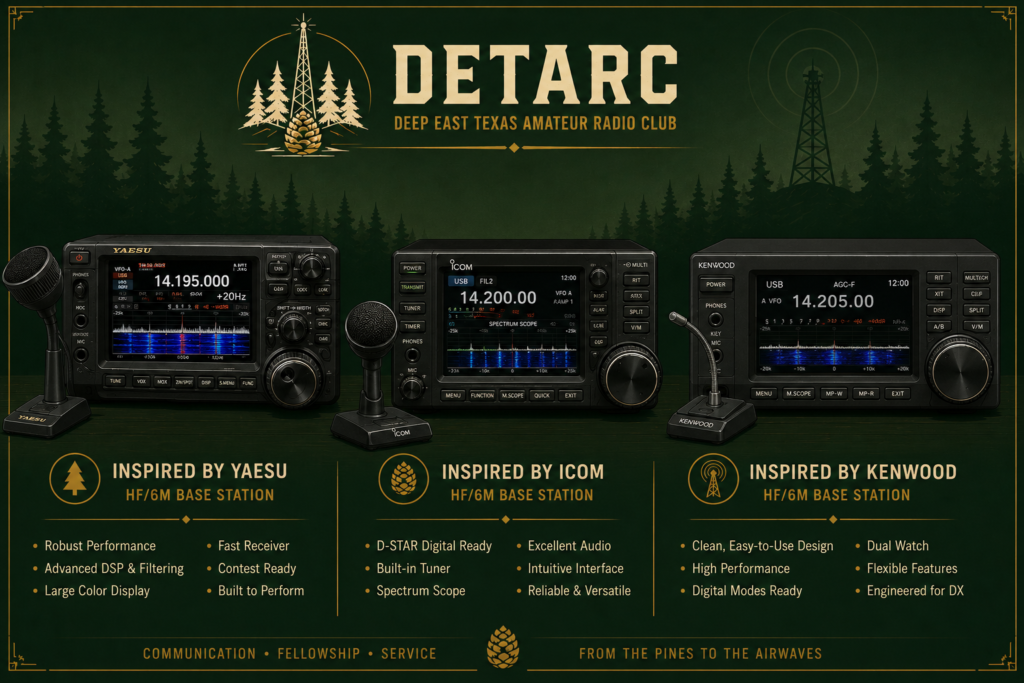
For many new amateur radio operators, the idea of owning a “real” base station is what first sparked their interest in the hobby. A radio sitting proudly on the desk, a microphone in hand, a good antenna outside—it just feels like amateur radio.
The good news? Building a home station has never been easier.
The bad news? Ask ten hams which radio you should buy, and you’ll get at least twelve opinions.
Choosing a first base station is a little like asking whether Ford or Chevy builds the better truck. Both camps are absolutely convinced they’re right, and neither is likely to change their mind anytime soon. Before long, someone will insist only Icom makes “real radios,” another will swear by Yaesu, and a third will quietly mutter that Kenwood hasn’t made enough new radios lately. Welcome to amateur radio.
The truth is that today’s major manufacturers all produce excellent equipment. There are differences, but none of them are bad choices.
The best radio is the one that gets you on the air.
What Is a Base Station?
A base station is simply a radio intended primarily for operation from your home.
Unlike a handheld or mobile radio, a base station is designed to stay put. It typically includes a larger display, more convenient controls, better speakers, and is paired with an outdoor antenna and a reliable power source.
Many operators keep the same base station for ten or even twenty years.
Should Your First Base Station Be VHF/UHF or HF?
As a new Technician license holder, your operating privileges are primarily on the VHF and UHF bands. That’s where you’ll find local repeaters, club nets, emergency communications, and casual conversations.
Because of that, many new operators choose one of two paths:
Option 1 — A Dedicated VHF/UHF Base Station
Ideal if your primary interest is local communication, public service, or emergency communications.
Option 2 — An HF Radio You Can Grow Into
Many HF transceivers also include 2 meters and 70 centimeters. While your Technician privileges on HF are limited, upgrading to General later unlocks an entirely new world of long-distance communication without needing to buy another radio.
If you think there’s even a reasonable chance you’ll upgrade your license, purchasing an HF radio now may actually save money in the long run.
What Makes a Good Base Station?
A good first base station should be:
- Easy to learn
- Comfortable to operate for long periods
- Have a good receiver
- Produce clean transmit audio
- Include modern filtering
- Be supported with software updates and accessories
Fancy features are nice.
Good ergonomics are nicer.
You’ll appreciate large knobs far more than an extra submenu after your first two-hour club net.
Recommended Base Stations
Best Budget VHF/UHF Base Station
Yaesu FTM-6000R
Although marketed as a mobile radio, the FTM-6000R makes an outstanding entry-level base station when paired with a quality 13.8-volt power supply.
Features include:
- 50 watts output
- Excellent receiver
- Large front-facing speaker
- Straightforward controls
- Outstanding value
If you’re primarily interested in local repeaters, it’s hard to beat for the price.
Best All-Around VHF/UHF Base Station
Yaesu FTM-500DR
One of the finest dual-band radios currently available.
Highlights include:
- Analog FM
- System Fusion digital voice
- APRS
- Dual receivers
- Large color display
- Excellent receive audio
Whether you’re chatting on the local repeater or participating in public service events, this radio does just about everything.
Best “Buy It Once” HF Base Station
Yaesu FTDX10
If you think you’ll eventually earn your General license, the FTDX10 deserves serious consideration.
It offers:
- Outstanding receiver performance
- 100 watts HF/6 meters
- Built-in antenna tuner
- Excellent DSP filtering
- Large waterfall display
- Support for digital modes
Many experienced operators consider its receiver one of the best values available today.
It’s a radio you probably won’t outgrow.
Premium HF Choice
Icom IC-7300
Ask hams for recommendations, and the IC-7300 is almost guaranteed to come up.
There’s a reason.
Features include:
- Direct sampling SDR architecture
- Excellent spectrum scope
- Touchscreen interface
- Superb digital-mode support
- Outstanding receiver
- Huge user community
If there were a “default recommendation” for someone’s first HF radio, this would probably be it.
Premium Enthusiast Choice
Icom IC-7610
Do you need this as your first base station?
Almost certainly not.
Will you smile every time you turn it on?
Absolutely.
Dual receivers, world-class performance, and enough features to keep you exploring for years.
Think of it as the sports car of amateur radio.
Don’t Forget the Rest of the Station
The radio is only one piece of the puzzle.
You’ll also need:
- A quality 13.8-volt regulated power supply (for VHF/UHF radios)
- A resonant outdoor antenna
- Low-loss coaxial cable
- Proper grounding
- Lightning protection
- A comfortable operating desk
Experienced operators know a secret:
A $500 radio with an excellent antenna will usually outperform a $2,000 radio connected to a poor antenna.
Spend your money wisely.
Essential Accessories
As your station grows, consider adding:
- An external speaker
- A desk microphone
- A headset for long nets
- A programming cable
- A logbook (paper or electronic)
- An antenna analyzer
- A quality SWR meter
- Anderson Powerpole distribution
You don’t need everything on day one.
Build your station over time.
Common Beginner Mistakes
Buying More Radio Than You Need
A radio with hundreds of features isn’t helpful if you’re overwhelmed by the menus.
Start with something you’ll actually enjoy using.
Ignoring the Antenna
It’s difficult to overstate this.
The antenna is usually more important than the radio.
Improving your antenna almost always produces greater results than upgrading your transceiver.
Forgetting About Future Goals
If you’re already planning to upgrade to General, buying an HF-capable radio now may actually save money later.
If you’re perfectly happy working local repeaters, a quality VHF/UHF station may serve you for decades.
Neither choice is wrong.
Listening Too Closely to Internet Arguments
Spend five minutes on an amateur radio forum and you’ll discover that every manufacturer is simultaneously the best ever made and hopelessly overrated.
It’s all part of the fun.
Ford vs. Chevy. Coke vs. Pepsi. Yaesu vs. Icom.
The good news is that all of the major manufacturers produce radios capable of providing years of reliable service.
Our Recommendations
Best Budget Base Station
A simple, reliable dual-band radio that makes an excellent first home station.
Best Overall VHF/UHF
Feature-rich without being intimidating.
Best Long-Term Investment
A legendary HF transceiver that many operators still consider the benchmark for first HF radios.
Best Value HF Radio
An exceptional receiver and room to grow as your operating interests expand.
Final Thoughts
Your first base station doesn’t need to be your forever radio.
It simply needs to get you on the air.
Operate. Join club nets. Experiment with antennas. Learn what kinds of operating you enjoy. As your interests grow, your station will naturally grow with you.
And if you eventually find yourself passionately defending your favorite brand in a friendly argument with another ham… congratulations. You’re officially one of us.

One Comment