
Choosing Your First Mobile Radio
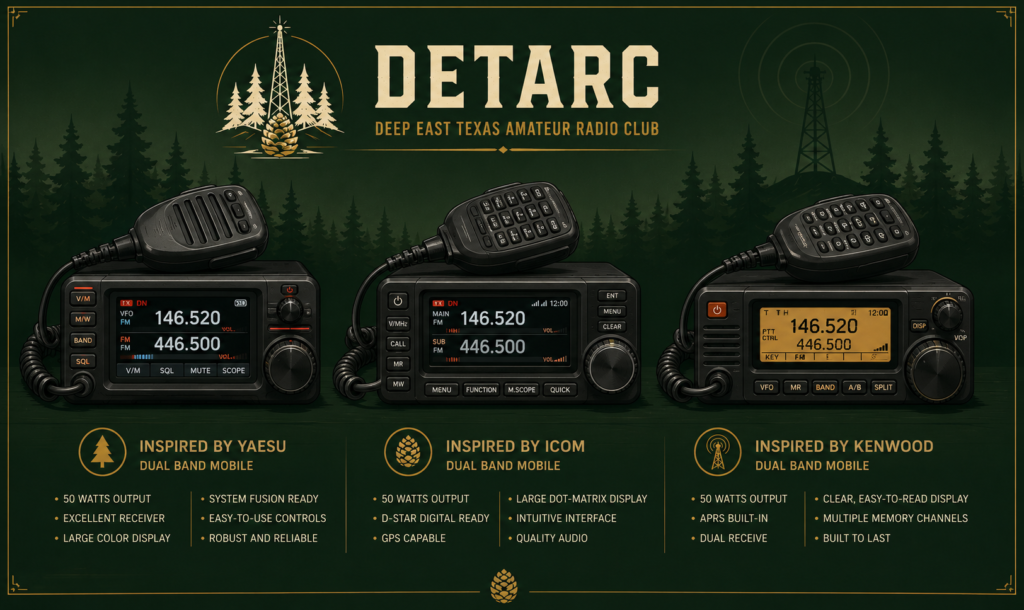
For many amateur radio operators, the first “real” upgrade after a handheld is a mobile radio.
Don’t let the name fool you. While these radios are designed for installation in a vehicle, many operators use them as their primary home station by pairing them with a 13.8-volt power supply and a good outdoor antenna.
If you’ve been frustrated by the limited range of your handheld, a mobile radio is often the single biggest improvement you can make.
Why Upgrade from a Handheld?
Most handhelds transmit at around 5 watts. Mobile radios typically transmit 25 to 50 watts, with some models reaching 75 watts on VHF.
That increase in power—combined with a better antenna—can dramatically improve your ability to reach repeaters and other stations.
But power isn’t the whole story.
Mobile radios also offer:
- Better receivers
- Louder, clearer audio
- Larger displays
- Easier controls
- More memory channels
- Improved durability
- Better heat dissipation for long conversations
You’ll likely find yourself spending less time navigating menus and more time enjoying the hobby.
Is a Mobile Radio Right for You?
A mobile radio is an excellent choice if you:
- Spend a lot of time driving
- Regularly participate in club nets
- Want to help with public service events
- Live near the edge of repeater coverage
- Want a home station without buying a large base radio
- Plan to become active in emergency communications
For many operators, it’s the best balance between performance and cost.
Vehicle or Home?
One of the biggest misconceptions is that mobile radios belong only in vehicles.
Many hams never install theirs in a car.
Instead, they connect it to:
- A 13.8-volt power supply
- An outdoor antenna
- A desk microphone (optional)
- An external speaker (optional)
This makes for an excellent home station while keeping costs relatively low.
Later, the radio can always be moved into a vehicle if your needs change.
Choosing the Right Features
Before comparing models, think about what matters to you.
Analog or Digital?
Every Technician should have an analog FM radio. The question is whether you also want digital voice capability.
Different manufacturers support different digital systems:
- Yaesu – System Fusion (C4FM)
- Icom – D-STAR
- Kenwood – D-STAR (on select models)
- AnyTone – DMR
Check what your local repeaters support before paying extra for a digital radio. If your area has only analog repeaters, digital capability may not provide much value—yet.
How Much Power?
You’ll commonly find:
- 25 watts – More than adequate for many situations.
- 50 watts – The sweet spot for most operators.
- 75 watts – Helpful if you’re routinely trying to reach distant repeaters.
More power can help, but antenna quality and placement often matter even more.
Cross-Band Repeat
Some radios can act as a relay between your handheld and a distant repeater.
This feature is particularly useful if:
- You’re working around your property
- You’re at public events
- You’re camping
- You want to extend the useful range of your HT
It’s a nice feature but not essential for a first mobile radio.
Recommended Radios
Budget Choice
BTECH UV-50X2
A capable dual-band mobile offering:
- 50 watts
- Dual receivers
- Affordable price
- Easy-to-read display
A solid entry point if you’re on a budget.
Great Value
Yaesu FTM-200DR
One of the best all-around values today.
Features include:
- Excellent receiver
- Analog FM
- System Fusion digital
- APRS support
- Large color display
If your area uses Fusion, this radio deserves serious consideration.
Premium Choice
Icom ID-5100A
A favorite among operators using D-STAR.
Highlights include:
- Large touchscreen display
- Outstanding receiver
- Dual-band operation
- GPS support
- Excellent audio quality
It’s more expensive, but many owners keep them for years.
DMR Favorite
AnyTone AT-D578UVIII Plus
If your club or local repeaters use DMR, this radio is one of the most capable available.
Features include:
- Analog FM
- DMR
- GPS
- Bluetooth (on some versions)
- APRS support
There’s a learning curve, but it’s a very capable radio.
Don’t Forget the Antenna
Here’s a secret experienced hams know:
The antenna is usually more important than the radio.
A modest mobile radio connected to a quality antenna will often outperform a premium radio connected to a poor antenna.
For vehicle installations, a properly mounted roof antenna usually performs better than lip mounts or magnetic mounts because it provides a better ground plane.
For home stations, installing an outdoor antenna as high as practical will generally make the biggest difference in your station’s performance.
If your budget is limited, don’t spend it all on the radio.
Installation Considerations
Installing a mobile radio is usually straightforward, but there are a few best practices.
Power
Run power directly from the vehicle battery using appropriately fused positive and negative leads. This minimizes electrical noise and ensures the radio has sufficient current when transmitting.
Mounting
Choose a location that:
- Doesn’t interfere with driving
- Allows good airflow
- Is easy to reach
- Doesn’t block airbags or vehicle controls
Antenna Placement
Whenever possible:
- Mount the antenna in the center of the vehicle roof.
- Use quality coaxial cable.
- Avoid sharp bends or pinched cables.
- Check the antenna’s SWR before transmitting at full power.
A well-installed antenna is worth far more than a few extra watts of transmitter power.
Accessories You’ll Appreciate
You don’t need to buy everything at once, but these accessories can make operating more enjoyable:
- External speaker
- Hand microphone with programmable buttons
- Programming cable
- CHIRP or manufacturer programming software
- Anderson Powerpole connectors
- Spare fuses
- SWR meter or antenna analyzer
Common Beginner Mistakes
Buying the most expensive radio first
A premium radio won’t overcome a poorly installed antenna.
Ignoring your local repeater network
There’s little value in buying a digital radio if no local repeaters support that digital mode.
Skimping on the antenna
Many operators regret spending their entire budget on the radio while leaving little for the antenna system.
Forgetting the power supply
If you plan to use the radio at home, remember to budget for a quality 13.8-volt regulated power supply capable of delivering the radio’s required current.
Our Recommendations
Best Budget Mobile
A solid analog dual-band radio for getting started without breaking the bank.
Best Overall Value
Excellent performance, intuitive operation, and digital capability make it a radio you can enjoy for many years.
Best Premium Choice
An outstanding performer with one of the best user interfaces available.
Best for DMR
A feature-rich option if DMR is active in your area.
Final Thoughts
A mobile radio represents a significant step forward from a handheld. Whether installed in your vehicle or operating from your desk at home, you’ll enjoy better audio, greater range, and a more comfortable operating experience.
Just remember: the radio is only part of the station. A quality antenna, proper installation, and regular participation in local nets will do more to improve your amateur radio experience than any feature list ever could.
If you’ve outgrown your handheld but aren’t ready to invest in a full HF station, a mobile radio is an excellent next step—and for many operators, it remains their most-used radio for years to come.

One Comment