

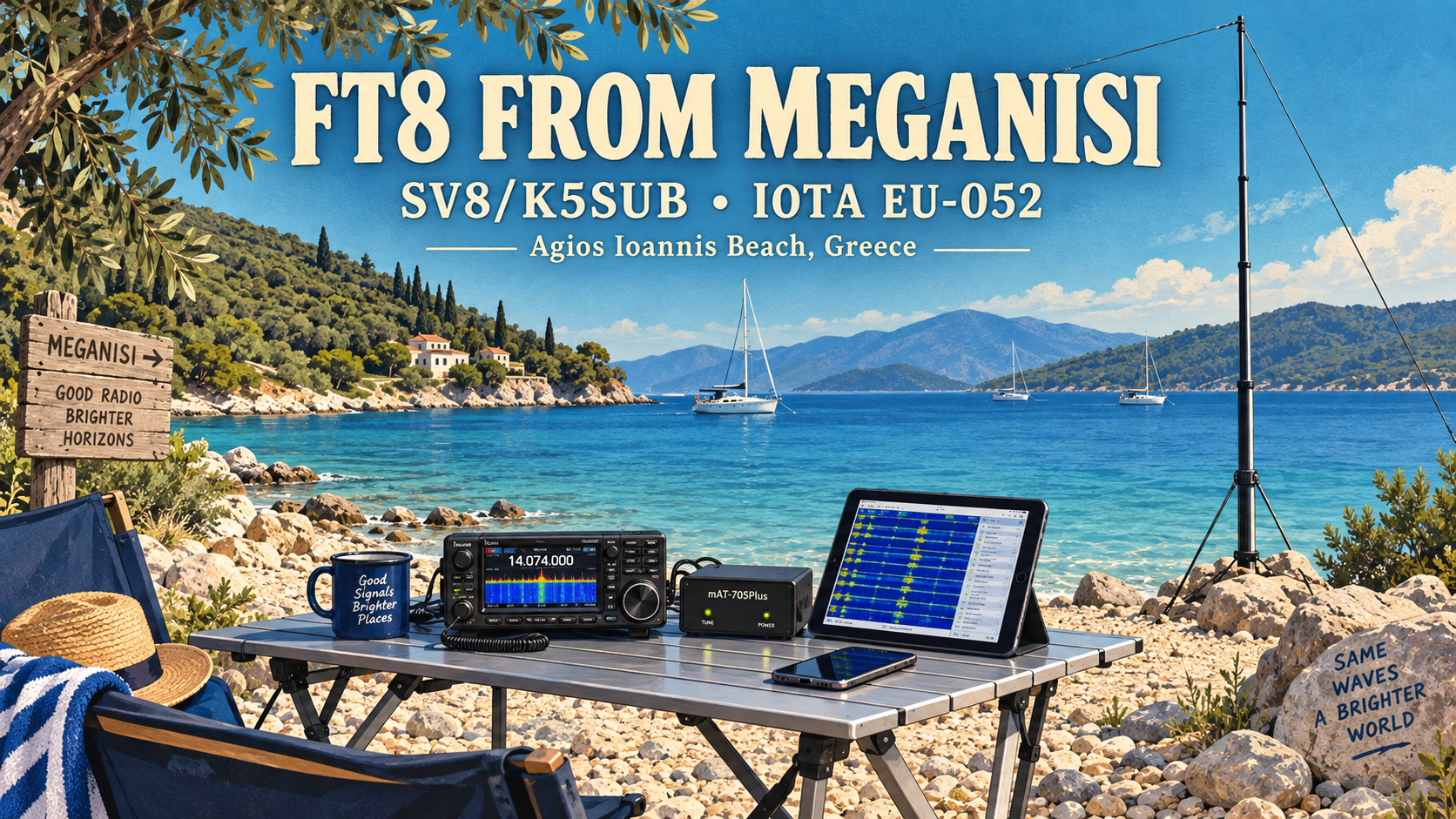
FT8 from Saint John Beach: My Meganisi IOTA Activation
By Danny Butler, K5SUB
On September 22, 2026, I operated from Agios Ioannis Beach (Παραλία Άγιος Ιωάννης, or Saint John Beach) on Meganisi, Greece, using the callsign SV8/K5SUB. I made five FT8 contacts on 15 and 20 meters, activating IOTA EU-052 during my visit.
It was a modest operating session, but a memorable way to combine travel with amateur radio. For fellow club members considering an overseas activation, here is how I approached the process—from establishing permission to operate to making the contacts available for IOTA credit.
The first step was checking operating authority. A U.S. amateur license does not automatically provide privileges in another country. For Greece, the applicable arrangement was CEPT Recommendation T/R 61-01, which provides reciprocal privileges for eligible visiting operators. U.S. Amateur Extra and Advanced licensees qualify under this arrangement in Greece, subject to Greek operating rules. Before traveling, I recommend checking the destination’s current requirements, including permitted bands, power limits, and callsign conventions. The Radio Amateur Association of Greece provides guidance for visiting amateurs.
Having the right paperwork is part of that preparation. A U.S. operator using CEPT privileges should carry an official FCC-issued license, proof of citizenship such as a passport, and the FCC’s multilingual CEPT Public Notice. I would also keep a copy of the applicable CEPT recommendation available offline. ARRL’s CEPT information explains the requirements and links to the documents.
For my Meganisi operation, the appropriate callsign was SV8/K5SUB. That identified my Greek operating location while retaining my home callsign. I used that station callsign on the air and in my log, with K5SUB identifying me as the operator.
Next came confirming that the island qualified for Islands on the Air, or IOTA. The program organizes qualifying islands into groups, each with a reference number that amateurs can collect through confirmed contacts. I checked the official directory and confirmed that Meganisi belongs to EU-052.
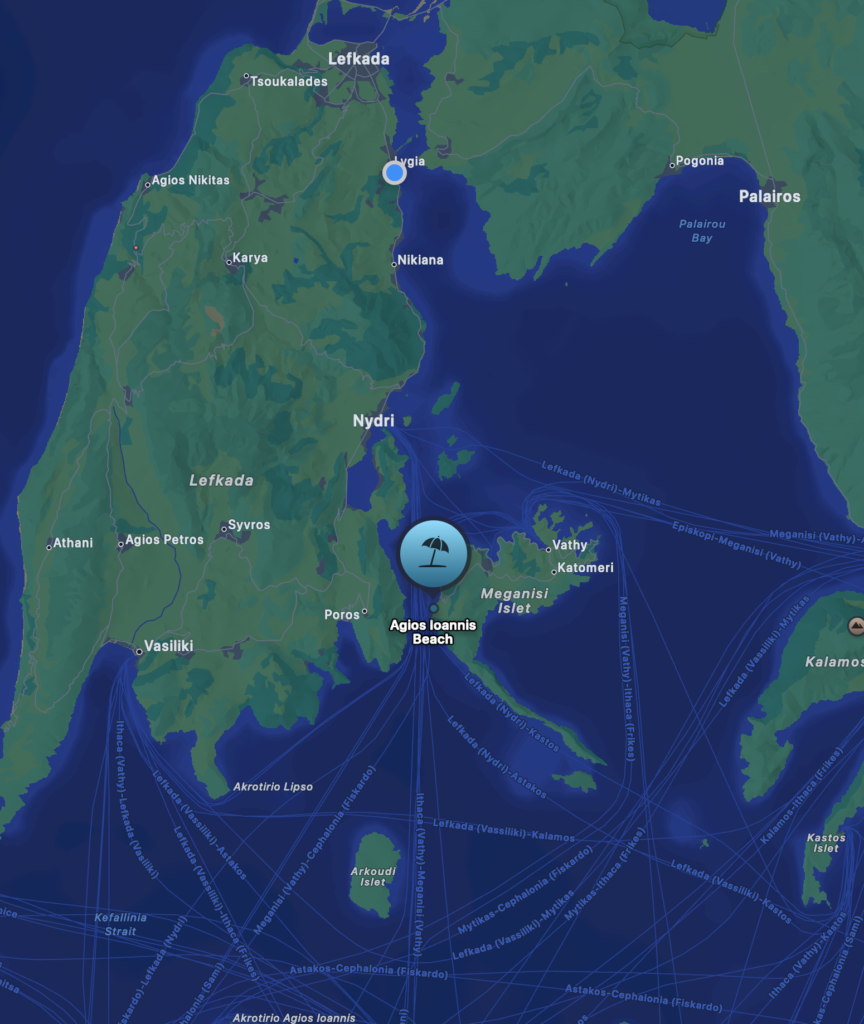
This is worth checking carefully. Nearby Lefkada, also called Levkas, is explicitly excluded from EU-052. An island’s appearance on a map does not necessarily mean it qualifies for IOTA. The official EU-052 directory lists the qualifying islands and exclusions.
My operating spot was Agios Ioannis Beach, in grid square KM08ip. Choosing a portable location also means considering access, permission where needed, space for the antenna, and a safe setup that does not interfere with other visitors. Recording the coordinates and grid square ties the log to the actual operating site.
My station centered on an Icom IC-705, paired with an mAT-705Plus antenna tuner and an end-fed half-wave (EFHW) spool antenna supported by a 26-foot telescoping mast. For control and FT8 operation, I used SDR-Control for Icom on an iPad, with the wireless connection provided through the WLAN hotspot on my iPhone.


That combination let me operate from the iPad while keeping the station portable. The spool antenna and telescoping mast were practical parts of a setup intended to travel with me, and the IC-705 brought HF capability to the beach without requiring a full home-station arrangement.
Once set up, I operated FT8 and completed five contacts with stations in Hungary, France, and the Netherlands. Three contacts were on 15 meters and two were on 20 meters. (Unfortunately, America was asleep when I activated. My next attempt will take into consideration time zones.)
For me, the appeal was being at the island end of those exchanges. Each contact connected that particular place on Meganisi with another amateur’s station—and potentially gave that operator a new island group to claim.
Accurate logging was an essential part of the activation. In addition to the other station’s callsign, UTC date and time, band, mode, and signal reports, I made sure my station information identified SV8/K5SUB, Greece, KM08ip, and EU-052. Those details need to describe where the contacts were made.
Afterward, I used Trusted QSL (TQSL) to sign the log for ARRL’s Logbook of The World (LoTW). I obtained a callsign certificate for SV8/K5SUB associated with Greece and created a dedicated Meganisi station location.
That station location contained:
- Callsign: SV8/K5SUB
- DXCC entity: Greece, 236
- Grid square: KM08ip
- CQ zone: 20
- ITU zone: 28
- IOTA reference: EU-052
I selected the Meganisi location when signing the exported ADIF log, then uploaded the signed log to LoTW. Keeping separate station locations for different operating sites helps ensure that each contact carries the correct geographic information. ARRL’s LoTW submission guide explains this process.
The final step was reporting the activation through Support → Report an IOTA Activation on the IOTA website. I entered SV8/K5SUB, Meganisi, EU-052, and the UTC dates and times of my first and last contacts. I supplied K5SUB as my home callsign, identified the LoTW log as SV8/K5SUB, selected Data for the FT8 contacts, and authorized LoTW QSO matching.
The report allows IOTA to associate the callsign and operating period with the correct island. My submission is complete; IOTA’s review and acceptance are separate steps before the activation is enabled for matching. The official activation-report instructions describe the required information.
Reporting the activation helps the people who worked me obtain island credit. It is separate from the website’s “Add QSOs from LoTW” feature, which retrieves qualifying contacts for an operator’s own IOTA award account.
My Meganisi activation was small, but it added something special to the trip. With a portable station, an iPad, and some advance preparation, I could enjoy operating from a Greek island and share that location with other amateurs.
If you are planning a trip, consider whether amateur radio could be part of it. Check the operating agreement, gather the documentation, verify the callsign and island reference, and plan a practical station. Then leave yourself time to sit down, call CQ, and see who answers.
While I am here in Greece, I will attempt more activations including SOTA and POTA.
73, Danny — K5SUB / SV8/K5SUB

Well done Danny. Would likr to have worked you.
Le us (DETARC folks) know your future schedule if practical.
AA5HH and I both do FT8/FT4 and both have amps if needed.
Enjoy,
Roger K0YY
Ex- W6SOT/3A, W6SOT/LX, DA2KR, Z2/K0YY, Eyyc.