
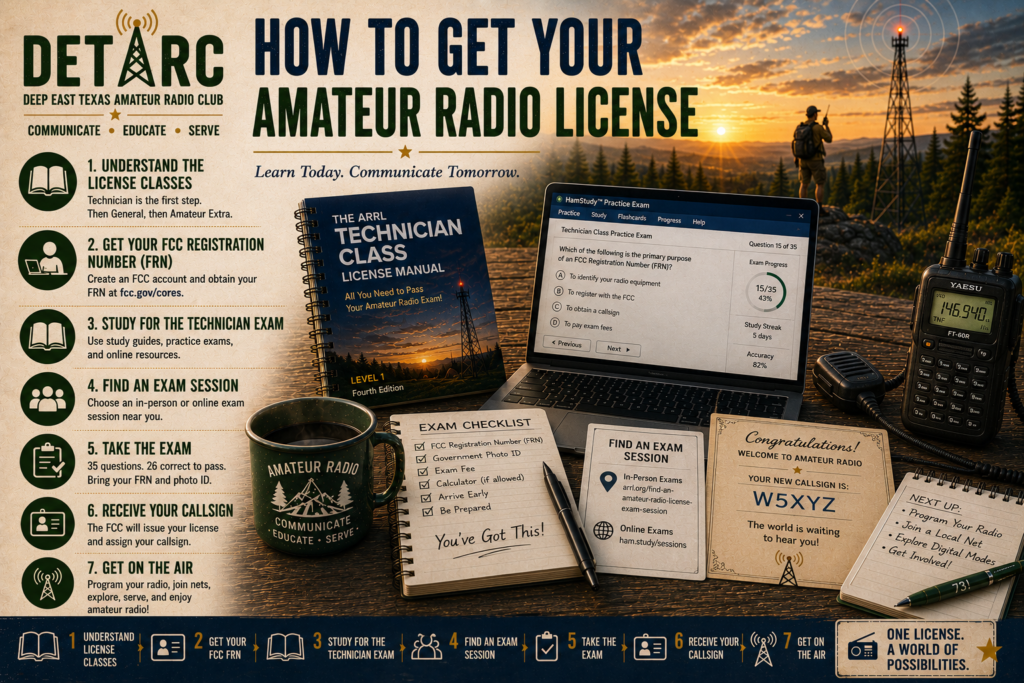
How to Get Your Amateur Radio License
Getting started in amateur radio is easier than many people think. Unlike commercial radio services such as FRS, GMRS, or CB radio, amateur radio operators are licensed by the Federal Communications Commission (FCC). The license demonstrates a basic understanding of radio regulations, operating practices, and safety.
The good news is that no Morse code is required, and most people can successfully earn their first license with just a few weeks of study.
This guide will walk you through the process from start to finish.
Step 1: Understand the Amateur Radio License Classes
In the United States, amateur radio licenses are issued in three levels:
Technician Class
The Technician license is the entry point into amateur radio and where nearly all new operators begin.
With a Technician license, you can:
- Use local VHF and UHF repeaters
- Participate in emergency communications
- Communicate through amateur radio satellites
- Use digital modes
- Access limited portions of the HF bands
General Class
After passing the Technician examination, operators may take the General examination.
The General license provides access to most HF amateur radio frequencies, allowing communication across the country and around the world.
Amateur Extra Class
After passing the General examination, operators may take the Amateur Extra examination.
Amateur Extra operators enjoy full amateur radio privileges and access to additional frequency segments unavailable to lower license classes.
How the Licensing Process Works
The FCC licensing system is progressive:
- Pass the Technician examination.
- Pass the General examination.
- Pass the Amateur Extra examination.
Many operators earn their Technician license first and upgrade later. Others choose to take multiple examinations during the same testing session. As long as each examination is passed in order, it is possible to earn all three license classes in a single day.
For most newcomers, the Technician license is the ideal starting point.
Step 2: Obtain an FCC Registration Number (FRN)
Before taking an amateur radio examination, you must obtain an FCC Registration Number (FRN).
Your FRN serves as your unique identifier with the FCC and is required before you can take an examination.
Visit the FCC CORES Registration System:
https://apps.fcc.gov/cores/userLogin.do
You will:
- Create an FCC account.
- Verify your email address.
- Receive your FRN.
Write down your FRN and bring it with you when you take your exam.
Step 3: Study for the Technician Exam
The Technician examination covers:
- FCC rules and regulations
- Radio operating procedures
- Electrical and radio fundamentals
- Antennas and propagation
- Safety practices
The exam consists of 35 multiple-choice questions.
A passing score requires 26 correct answers.
Recommended Study Resources
HamStudy
One of the most popular study resources available. HamStudy provides:
- Practice exams
- Flash cards
- Study tracking
- Online testing information
ARRL License Resources
https://www.arrl.org/studying-for-a-technician-license
The ARRL provides study guides, books, and learning resources specifically designed for the Technician examination.
Practice Exams
Taking practice tests is one of the best ways to prepare.
A good goal is to consistently score 85% or higher on practice exams before scheduling your test.
Step 4: Find an Exam Session
Amateur radio examinations are administered by Volunteer Examiners (VEs).
Exams are available both in-person and online.
The DETARC VE team tests monthly on the 3rd Saturday of each month. See Amateur Radio Testing for more information.
Find an In-Person Exam
ARRL Exam Search:
https://www.arrl.org/find-an-amateur-radio-license-exam-session
Find an Online Exam
HamStudy Exam Sessions:
Many applicants find online testing to be the quickest and most convenient option.
Step 5: Take the Exam
On exam day, you will typically need:
- Your FCC Registration Number (FRN)
- A government-issued photo ID
- Any required exam fee
- A calculator if permitted by the exam team
The Technician examination contains:
- 35 multiple-choice questions
- A passing score of 26 correct answers
Most examination teams grade the test immediately.
If you pass, your paperwork will be submitted electronically for FCC processing.
Step 6: Receive Your Callsign
After your exam results are processed, the FCC will issue your amateur radio license and assign a callsign.
Most applicants receive their license within a few days, although processing times can vary.
You can search for your license here:
https://wireless2.fcc.gov/UlsApp/UlsSearch/searchLicense.jsp
Once your callsign appears in the FCC database, you are officially licensed and may begin transmitting.
Step 7: Get On the Air
Congratulations! You are now a licensed amateur radio operator.
Many new operators begin by:
- Programming local repeaters into a handheld radio
- Participating in local nets
- Assisting with public service events
- Exploring digital modes
- Learning emergency communications techniques
- Joining local amateur radio clubs
Don’t worry about learning everything at once. Amateur radio is a hobby with many different paths, and your interests will naturally guide where you go next.
Helpful Resources
FCC Registration
FCC CORES Registration System
https://apps.fcc.gov/cores/userLogin.do
Practice Exams
HamStudy
ARRL Study Materials
https://www.arrl.org/studying-for-a-technician-license
Find an Exam Session
https://www.arrl.org/find-an-amateur-radio-license-exam-session
Online Exam Sessions
Search FCC Licenses
https://wireless2.fcc.gov/UlsApp/UlsSearch/searchLicense.jsp
Need Help?
The Deep East Texas Amateur Radio Club (DETARC) is committed to helping new operators get started. Whether you have questions about studying for the exam, selecting your first radio, or getting involved in local activities, we would be happy to help.
We look forward to hearing you on the air!