
Choosing Your First HF Radio
Excerpt: New Technician ham in Lufkin or Deep East Texas? Learn choosing a first hf radio with practical, beginner-friendly guidance from DETARC.
The Short Version
Your first HF radio should fit your license, antenna, budget, and growth plans—not just the online review that sounded exciting.
If you are newly licensed, do not measure success by how much you already know. Measure success by the next good step you actually take. This article gives you that next step for choosing a first hf radio.
Why This Matters for a New Technician
The Technician license is more useful than many people realize, but it can feel confusing because amateur radio is not one hobby. It is a collection of skills: local communication, antennas, emergency readiness, digital tools, portable operating, experimentation, and friendship with people who enjoy helping each other learn.
This topic matters because it moves you from owning a radio to using radio purposefully. You are not just collecting equipment. You are learning how to communicate, how to listen well, how to serve your neighbors, and how to become a reliable part of the local amateur-radio community.
What You Need Before You Start
- Your FCC callsign and a willingness to identify clearly.
- A radio appropriate for the activity. For many local topics, a VHF/UHF handheld or mobile radio is enough to begin.
- Current frequency, tone, and band-plan information before transmitting.
- A notebook or digital log for settings, questions, and contacts.
- Patience. Radio learning is built one successful attempt at a time.
Step-by-Step Beginner Path
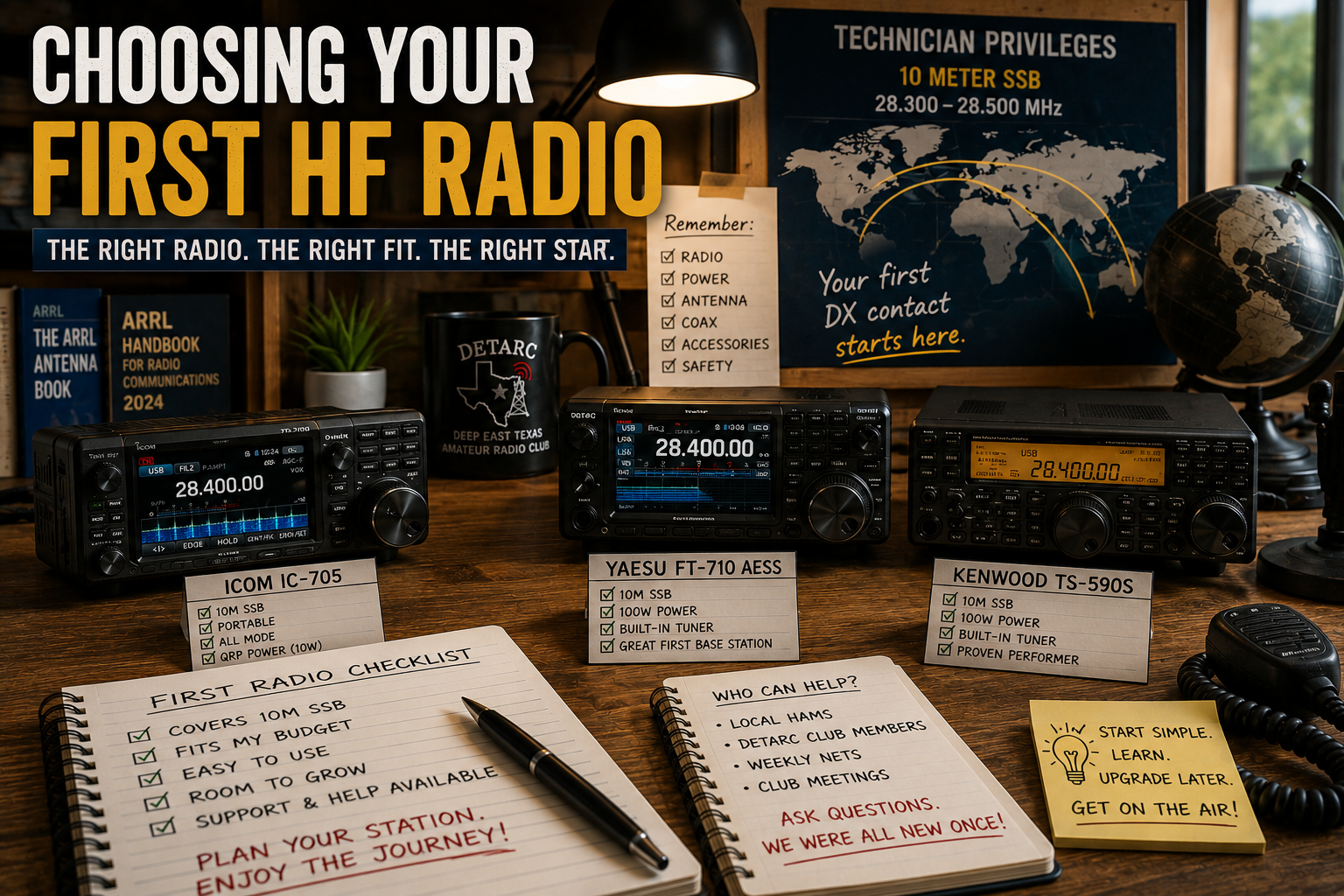
- Confirm it covers 10-meter SSB.
- Consider whether you plan to upgrade.
- Budget for power, antenna, coax, and accessories.
- Try a radio before buying if possible.
- Get help checking used gear.
Common Mistakes to Avoid
- Buying HF without budgeting for the station.
- Ignoring menu usability.
- Buying damaged used equipment alone.
- Forgetting antenna safety and grounding.
A Simple First-Week Challenge
Make a whole-station budget before choosing the radio model.
How This Connects to the Bigger Hobby
Every skill in amateur radio connects to something larger. Local repeater practice prepares you for nets. Nets prepare you for public-service events. Antenna experiments improve portable operating. Logging helps with HF, POTA, satellites, and awards. Digital tools teach you how radio and computers can work together when normal infrastructure is limited or overloaded.
The point is not to become an expert overnight. The point is to build dependable habits: listen first, identify properly, ask good questions, take notes, and help the next new operator when it is your turn.
Come Learn With DETARC
Amateur radio is easier when you do not have to learn alone. DETARC exists to help operators in Lufkin, Angelina County, and Deep East Texas grow in skill, confidence, and service.
- Weekly net: Tuesdays at 8:00 PM
- Primary repeater: 146.940 MHz, PL 141.3
- Club meeting: 4th Thursday at 6:30 PM, Fuller Springs VFD
Bring your callsign, your questions, and your radio if you have one. New operators are welcome here.
Choose Your Next Adventure
- Back to the landing page: You Passed Your Technician Exam. Now Choose Your First Amateur Radio Adventure.
- Current adventure: Adventure 2 — I Want to Talk Farther Away
- Next suggested article: Logging Contacts
Frequently Asked Questions
Do I need expensive equipment to begin?
Usually, no. Start with the equipment that fits the activity and ask local operators before making a major purchase. The best first station is often the one you understand and will actually use.
What if I make a mistake?
You probably will, and that is normal. Keep it courteous, identify with your callsign, correct what you can, and learn from it. Every experienced operator was new once.
Is this something DETARC can help with?
Yes. DETARC is a local club, which means you can learn from people who know the repeaters, terrain, common radios, useful antennas, and real operating conditions around Deep East Texas.

Danny, FYI Here is the previous article aimed more at the General Licensee.
BUYING HAM GEAR, WHAT TO LOOK FOR— AN OVERVIEW
1. GENERAL RULES FOR ALL PURCHASES:
A. DECIDE WHAT YOU CAN AFFORD– PRICE
B. DEFINE HOW YOU WILL USE IT—CASUAL VS INTENSE, MULTI-MODE
C. DECISION– BUY BASIC NOW VERSUS MORE CAPABILITY/FEATURES
D. COMPARISON SHOP— HRO, AES, UNIVERSAL, HOUSTON ARS
E. NEW VERSUS USED— NEW WARRANTY VERSUS PRICE
F. AES AND HRO HAVE SOME USED GEAR, HAMFESTS, LOCAL CLUBS
G. GATHER INFO– CHECK REVIEWS AT ARRL & ON WEB— EHAM, QRZ
H. MANUFACTURER/MODEL REPUTATION– REVIEWS
I.
GOOD TO HAVE SOME RECOURSE IF PROBLEM— KNOW SELLER
2. VHF/UHF HANDHELDS:
A. PRICE
B. POWER—MANY NEW UNITS– MAX 5 WATTS— POWER SAVER STEPS
C. ANTENNA CONNECTOR— CONNECT EXTERNAL ANTENNA?
D. SINGLE VERSUS DUAL BAND— NEED 440 MHZ?
E. SINGLE RF DECK VERSUS DUAL
(TRUE DUAL BAND— TWO FREQUENCIES DISPLAYED)
F. TONE ENCODE AND DECODE
G. MEMORIES— KEEP YOUR SETTINGS
H. CASE QUALITY—STURDY?
I.
BATTERY SIZE—GOOD CAPACITY—1100-1400 MAH
J. ACCESSORIES— 120 VAC & 12 VDC CHARGERS, SPEAKER MICS,
K. PC PROGRAMABLE— SOFTWARE AVAILABLE
L. OTHER— WATER RESISTANT, WEATHER CHANNELS, WIDE RECEIVE
M. SPECIAL MODES— ICOM– D-STAR, YAESU– WIRES
3. VHF/UHF MOBILES:
A. PRICE
B. POWER
C. SINGLE VERSUS DUAL BAND, MULTIBAND
D. SINGLE RF DECK VERSUS DUAL DECK
E. TONE ENCODE AND DECODE
F. MEMORIES
G. REMOVABLE FRONT PANEL— EASE OF INSTALL IN VEHICLES
H. CROSSBAND REPEAT— USE TO EXTEND RANGE OF HANDHELDS
I.
OTHER— WEATHER CHANNELS, WIDE RECEIVE
J. PC PROGRAMABLE/INTERFACE TO PC FOR PACKET
K. SPECIAL MODES— DIGITAL, SSB
4. HF MOBILES:
A. PRICE
PAGE 1
DETARC PRESENTATION BY K0YY
B. BANDS- 160-10, 6M, 2M
C. MODES—SSB, CW, FM, AM, DIGITAL
D. MEMORIES
E. FILTERS— DSP, BAND PASS, CRYSTAL FILTERS
F. EASE OF USE— MENUS VERSUS BUTTONS
G. PROGRAMABLE FROM PC
H. SPECIAL FEATURES– TX AUDIO COMPRESSION
5. HF BASE STATIONS:
A. PRICE
B. BANDS— 160-10 PLUS, 60, 6, 2
C. MODES—SSB, CW, DIGITAL, AM , FM
D. MEMORIES— MULTIPLE IN BAND MEMORIES
E. FILTERS– DSP, AUTOMATIC NOTCH FILTER
F. DUAL VFOs—A & B
G. SPILT FREQUENCY OPERATION—DX & 40 METER SSB
H. RECEIVER SPECS— SELECTIVITY, SENSITIVITY, DISTORTION,
ADJACENT CHANNEL OVERLOAD REJECTION, NOISE FLOOR
I.
TRANSMITER SPECS—ADJUST AUDIO CHARACTERISITICS
J. BUILT IN CW KEYER
K. VOICE/CW MEMORY—CONTESTS, DXING
L. ACCESSORY HOOKUPS— DIGITAL, AMPLIFIER,
M. BAND SCOPE— SEE SIGNALS
N. BUILT IN AUTO-TUNER
6. REFERENCE WEB SITES:
A. ARRL— http://WWW.ARRL.ORG OPERATING, REVIEWS, NEWSLETTERS,
ARES, NPOTA, LOTW
B. QRZ— http://WWW.QRZ.COM CALL SIGN LOOKUP, REVIEWS, DX
C. EHAM– http://WWW.EHAM.COM HAM INFO, EQUIPMENT REVIEWS, DX
D. AES— AMATEUR ELECTRONIC SUPPLY— http://WWW.AESHAM.COM NEW
AND USED EQUIPMENT, ACCESSORIES, SUPPLIES
E. HRO— HAM RADIO OUTLET- http://WWW.HAMRADIO.COM NEW EQUIPMENT
ACCESSORIES, SUPPLIES, CONSIGNMENTS
F. UNIVERSAL– http://WWW.UNIVERSAL-RADIO.COM NEW EQUIPMENT,
ACCESSORIES, SUPPLIES
G. HOUSTON– http://WWW.HARSRADIO.COM NEW EQUIPMENT, CONSIGNMENT
H. RFSTUFF— http://WWW.RFSTUFF.COM RADIO ACCESSORIES & SUPPLIES,
GOOD PRICES
I.
QTH.COM— http://WWW.QTH.COM HAM INFO, EQUIPMENT FOR SALE,
READ SAFE BUYING TIPS
J. TEXAS TOWERS— http://WWW.TEXASTOWERS.COM TOWERS, ANTENNAS
COAX, ACCESSORIES
K. MFJ— http://WWW.MFJENTERPRISES.COM ACCESSORIES, SUPPLIES
Roger, your comment contains an outline. Do you have a manuscript or actual article that can be posted?