
You Passed Your Technician Exam. Now What?
First of all: congratulations.
Earning your Technician license is a real accomplishment. You learned new rules, new language, new technology, and probably a few things that sounded like they belonged in an engineering textbook.
Then the FCC issued your callsign. You bought a handheld radio, programmed a local repeater, turned up the volume… and maybe heard almost nothing.
If that sounds familiar, you are not alone. Many new amateur radio operators reach this exact point. The exam is behind you, but the hobby still feels like a locked door.
The door is not locked. You just need a first step.
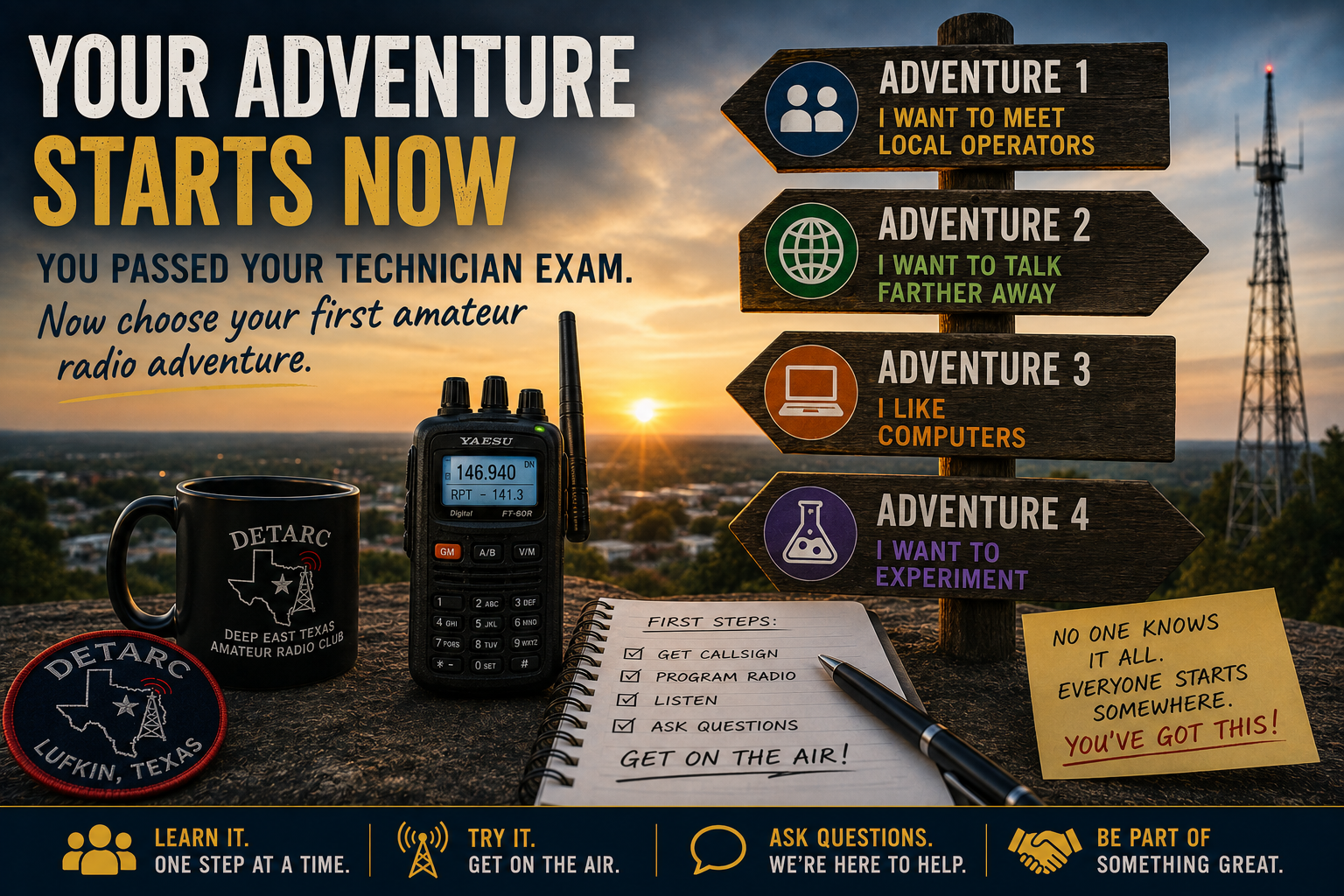
Choose Your Own Amateur Radio Adventure
Amateur radio is not one single hobby. It is a whole collection of hobbies that happen to use radio. Some operators enjoy casual local conversations. Some like emergency communications. Some build antennas. Some chase parks, satellites, digital modes, or faraway stations on HF. Some simply enjoy being part of a local community of people willing to help each other learn.
You do not have to learn all of that at once. Start with the adventure that sounds most useful to you right now.
Adventure 4 — I Want to Experiment
Start here if you want to try satellites, Parks on the Air, field operations, antennas, go kits, Field Day, emergency communications, and the path toward General Class.
This is the adventure for operators who learn by doing. You will build, test, carry, listen, adjust, and try again.
Your Local Starting Points
If you are in or near Lufkin, here are three easy ways to begin:
- Listen to the DETARC repeater: 146.940 MHz, PL 141.3
- Check into the weekly DETARC net: Tuesdays at 8:00 PM
- Visit a club meeting: 4th Thursday at 6:30 PM, Fuller Springs VFD
You do not have to arrive knowing everything. Nobody does. Bring your questions. Bring your radio if you have one. Bring the courage to say, “I’m new, and I’m trying to learn.”
That sentence is welcome here.
How the Learning Path Works
1. Pick Something Interesting
There is no required curriculum and no test at the end. Choose the part of amateur radio that interests you right now.
2. Follow the Adventure
Each adventure contains a sequence of practical guides designed to take you from “I’ve heard of that” to “I think I can actually try this.”
At the end of each guide, we’ll point you toward the next logical step.
3. Change Direction Anytime
Amateur radio doesn’t fit neatly into categories.
Portable operating leads to antennas. Antennas lead to HF. HF leads to propagation. Computers lead to digital modes. Emergency communications leads to portable power. One interest inevitably leads to another.
Follow the rabbit trails. That’s part of the hobby.
Learn It. Try It. Get on the Air.
You don’t need to understand everything before you start.
In fact, you won’t.
Every experienced amateur radio operator was once the person staring at a radio wondering which button to press and hoping nobody noticed.
Pick something that interests you. Learn enough to try it. Ask questions. Make mistakes. Try again.
The goal isn’t to know everything about amateur radio.
The goal is to get on the air and discover what you enjoy doing with it.