
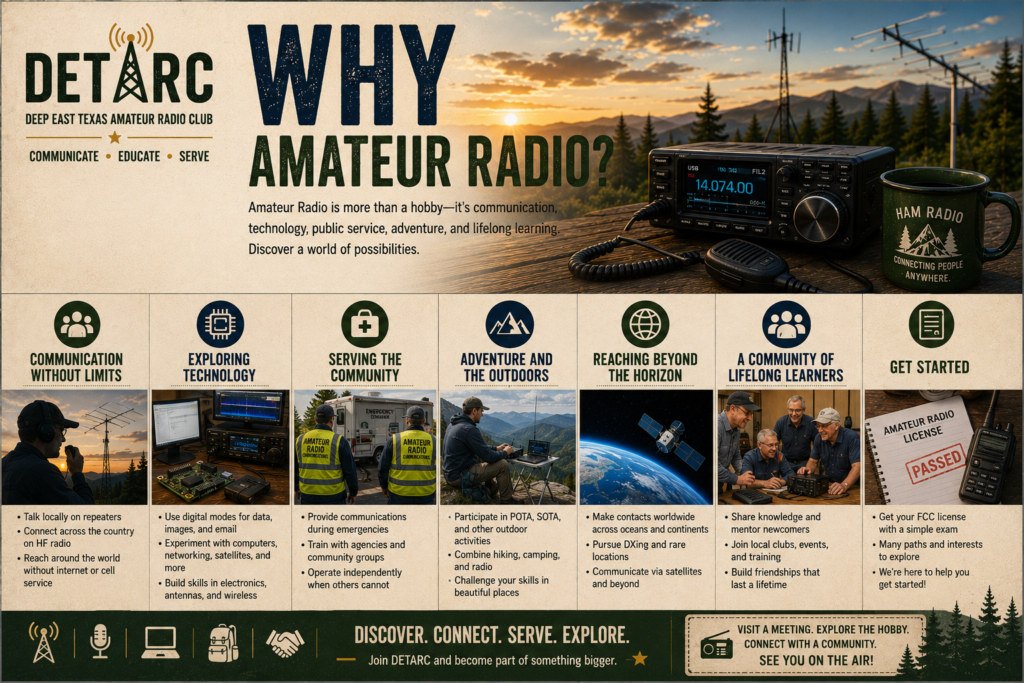
Why Amateur Radio?
Amateur Radio, often called “ham radio,” is one of the oldest and most versatile forms of wireless communication. For more than a century, radio amateurs have connected people across towns, states, countries, and continents using equipment they build, modify, and operate themselves.
While many people picture amateur radio as simply talking on a microphone, the hobby has evolved into much more. Today, amateur radio combines communication, technology, public service, education, and outdoor adventure into a lifelong pursuit with something for nearly everyone.
Communication Without Limits
At its core, amateur radio is about communication. Operators can communicate locally through community repeater systems, across the country using high-frequency (HF) radio, or even around the world without relying on the internet, cellular networks, or commercial infrastructure.
Whether it’s a casual conversation with a friend across town or a contact with someone on another continent, amateur radio offers unique opportunities to connect with people from all walks of life.
Exploring Technology
Amateur radio has a long tradition of innovation. Many modern communications technologies were pioneered, tested, or advanced by amateur radio operators.
Today’s amateur radio enthusiasts use much more than voice communication. Digital modes allow operators to exchange text messages, emails, images, telemetry, and other forms of data using radio signals and computers. Small computers such as Raspberry Pi devices are often used alongside radios to experiment with networking, automation, satellites, and emerging technologies.
For those who enjoy learning, building, and experimenting, amateur radio provides endless opportunities to develop technical skills in electronics, antennas, computers, networking, and wireless communications.
Serving the Community
Amateur radio is also recognized as a public service. During emergencies and disasters, traditional communication systems can become overloaded or fail entirely. Amateur radio operators are trained to establish independent communication networks when other systems are unavailable.
Many volunteers participate in emergency communications organizations and regularly train alongside emergency management agencies, hospitals, relief organizations, and community groups. Using portable stations powered by batteries, solar panels, or generators, amateur radio operators can provide critical communications in challenging environments when they are needed most.
Throughout history, amateur radio has played an important role in disaster response, helping communities stay connected when conventional communication systems were disrupted.
Adventure and the Outdoors
Amateur radio isn’t limited to the shack or radio room. Many operators enjoy taking their equipment into the field.
Programs such as Parks on the Air (POTA) and Summits on the Air (SOTA) encourage operators to combine radio with hiking, camping, and outdoor exploration. Participants set up portable stations in parks, forests, and mountain summits while making contacts across the country and around the world.
These activities provide a fun way to enjoy nature, practice portable communications, and challenge operating skills.
Reaching Beyond the Horizon
One of the most exciting aspects of amateur radio is its ability to communicate over great distances. Operators regularly make contacts across oceans and continents using radio waves that travel around the globe.
Some enthusiasts pursue rare locations through “DXing,” the pursuit of long-distance and international contacts. Others communicate through amateur radio satellites orbiting the Earth, making contacts hundreds or even thousands of miles away using equipment that can fit in a backpack.
The possibilities range from local neighborhood conversations to worldwide communication and even contacts through space.
A Community of Lifelong Learners
Perhaps the greatest strength of amateur radio is its community. Amateur radio operators enjoy sharing knowledge, mentoring newcomers, and helping one another learn and grow.
Local clubs, training events, public demonstrations, and gatherings provide opportunities to meet others who share an interest in technology, emergency preparedness, public service, and communication. Many operators find that the friendships they build become just as rewarding as the hobby itself.
Because amateur radio encompasses so many different activities—voice communication, digital modes, emergency communications, contesting, satellites, portable operations, electronics, and experimentation—it offers a lifetime of opportunities to learn something new.
Get Started
Becoming a licensed amateur radio operator is easier than many people expect. In the United States, obtaining an FCC amateur radio license begins with a simple entry-level examination covering basic operating practices, regulations, and safety.
Whether your interests are technology, emergency preparedness, outdoor activities, public service, or simply meeting new people, amateur radio offers a unique and rewarding way to explore the world of wireless communication.
We invite you to learn more, visit one of our meetings or events, and discover why millions of people around the world enjoy amateur radio.